Friday, June 6, 2014

D-Day: A Melancholy, Heroic Life.


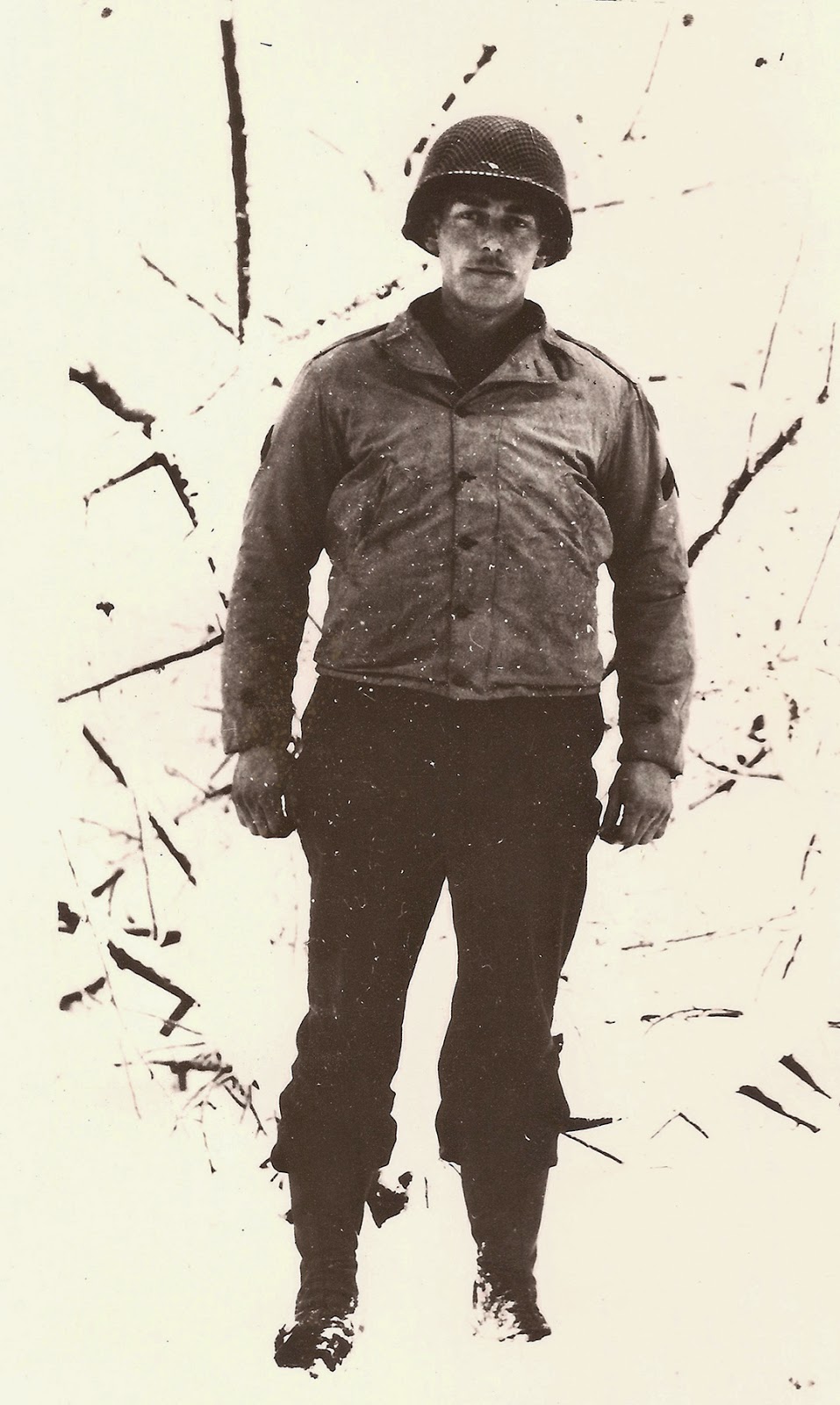
My father was born 17 July, 1918 and died 7 April, 2000 at age 81. He himself was raised fatherless, his own father having died in 1922 when my dad was only four years old. He remembered nothing of his own father, with the exception of the constant coughing fits in a German apartment, which were a precursor to his death from pneumonia and gangrene of the lungs in 1922 in Bonn. This was after the great flu pandemic of 1918, but I do wonder if that's what did him in. 


In doing some genealogical research last winter I uncovered (online, of all places, and quite randomly)  the passport applications of my grandparents, my uncle and my father—eerie snapshots of a young family about to embark on a new life in Europe, not knowing that the man of the house would be dead within months. My father was 3 years old. He's the small child in the center of the third photograph. 


My dad had a long and challenging life. He grew up in decadent, mob-infested Atlantic City in the 1920's and 30s. He told the story from time-to-time of watching from his window as Dutch Shultz' men shot from the bushes of the house next door at windows on the second floor. When I was about ten, I found a photo of him at the same age.  If not for the uber-masculine, defiant expression on his face, I was looking in a mirror. There he was on an Atlantic City sidewalk, dressed in a shirt and tie and sitting on a pony: chin thrust forward, scowling brow, piercing blue eyes.  I remember having the uneasy feeling that he would have been my nemesis if we had been boyhood neighbors. He scared me.


Dad learned to swim when he was thrown off a bridge by his bully of a brother (five years his senior, aided by a bunch of neighborhood toughs). With his father dead and his brother a juvenile delinquent who spent most of his time carousing with other punks from the neighborhood, my dad was left to wait on a house full of spinsters and widows. His mother returned from Germany to Atlantic City to be with her sisters and mother for many protracted years of mourning (I have seen photos of her in black dress and veil in bright sunlight on the Boardwalk—a frail, inky specter of grief who couldn't let go of loss). My father lived in the big, old, tudor house at 4710 Theresa Place with his grandmother, mother and four maiden aunts, all psychically exhausting women who knew nothing of responsibility, having been pampered all their lives by their father, a wealthy railroad man who had long since left behind life on earth and a comfortable salary. But there were stories of fun (or, at least, funny) times too. My dad bragged about having broken too many bones to count with stunts like jumping from balconies with his neighbor and boyhood pal Billy Fox. He loved hanging out on the beach all day to idolize the legendary Atlantic City lifeguards, and he told me stories about beating sand sharks to death on the shore, just for the hell of it, of sun poisoning, and of cutting open his palm while trying to skim slate over the ocean waves.  One of the brightest moments of his life occurred in October 1927, when Charles Lindbergh landed his plane at Bader Field in Atlantic City, following his earth-shifting, heroic transatlantic flight. My father had laid in the grass all day, his nine-year-old eyes scanning every inch of the sky for the wings of the Spirit of St. Louis, inscribed with large block letters: NX-211. He saw the plane fly right overhead and rushed to the airport. What a thrill that must have been.


Having left for the University of Virginia, where he was president of his fraternity and captain of the swim team (but unhappy in both roles because, as he said, his main responsibility was to keep drunk college boys out of trouble), my father enlisted post-college on 13 December 1941 and was shipped off to Europe to join the allied forces. Twenty-three years old, he indicated on his enlistment form (which I also, miraculously, found online) that his occupation was "actor." This puzzled and amused me; my mom explained that he and Billy Fox, unsure of what their lots in life would be, had planned to leave for Hollywood and make it in show business. "We're both good-looking fellas" Billy had said. 

My dad was (tragically) on board the Queen Mary on 27 September 1942, when it cut through the much smaller British cruiser, HMS Curaçao, killing 329 of the 430 men on board. On his way to join the allied forces of the War, he was sleeping in his bunk after a night of duty (in what was once the cocktail lounge of the luxury liner during its non-military years) when the Queen Mary rammed the Curaçao. I have some articles about that too—one with a photocopy of the Queen Mary marked up with his meticulous handwriting, noting the position of his quarters on the ship.


My mom became a voice for whatever war narratives he would allow to unravel. The most harrowing of these experiences may have been his involvement in the battle of Normandy on Omaha Beach on D-Day, exactly 70 years ago today. Undoubtedly, he experienced both grief and intense fear, and while news media contacted him many times over the years to tell his story, he always declined. I've learned over the years that many of those men were reluctant to discuss the experience. It must have been horrible. I feel fortunate that he did relate the facts to my mom, who is now 94. She shared this brief account of his experience in 1998:

Hank Brinkerhoff was with the famed 29th Division. The 111th Field Artillery (his outfit) followed the 116th Infantry Regiment, the first to arrive on Omaha Beach on D-Day. The 11th were to be the infantry simultaneous back-up but the DUC upon which the 111th loaded their artillery, equipment and men, sank almost immediately. Hank and others in his battery remained afloat until rescued one hour later by an LST. Taken aboard, they were given the only dry uniforms available, U.S. Navy, and the only protective helmet for Hank was one with a corpsmen's red cross (a badge he sadly remembers he could not honor with expertise as he later, on the beach, made his way among the many fallen).


Leaving the LST, the then only replacement to the sunken DUC were makeshift rafts, pontoon type, strung together, upon which they set out to get to the beach, this time with no artillery, not even a rifle or slightest defense. The description of landing on the the beach, Hank has always avoided except to say, "it was utter chaos and everyone was running like hell." He made it to the seawall, picked up a bayonet, punched a hole in this too-big Navy pants and tied them together. Then, along with a couple of buddies, went back to the water's edge to bring back a wounded member of the battery. Someone had morphine and after administering it to the suffering fellow, and marking his forehead with "M," they carried him back to the seawall. There they remained until dark when they made it up the rocky slope which their sacrificial 116th Infantry colleagues has cleared early a.m. Staying there until other ships and supplies landed, they sought out survivors of their 11th artillery, regrouped and went on to St. Lo, all through France, part of Holland and on to the Ruhr River in Germany.

His war experience rendered him eternally grim during his later years as a family man. By the time I was born in 1962, my father was 44 years old. Personally, having fathered my own three children while relatively young, between the ages of 25 and 30, I can't imagine trying to muster up the enthusiasm and love necessary to raise three tiny children, especially withstanding for so many years such compounding agents of sorrow and anxiety. When I was growing up, he was an impatient, cool, detached man. He almost never looked at me when he spoke. Habitually, he clicked his tongue in disgust, and heaved tremendous sighs (something my sisters and I have all inherited, unfortunately). By the time I came along as the last of three children he was pretty miserable. He simply didn't know how to play, but that's hardly surprising. Only after he retired in 1980, when his health began its inexorable decline, did he soften so graciously and tell me that he loved me. Coincidentally, 1980 is the year I started college, so my departure also did something to lighten his step, I'm sure. I am so grateful that he and I laughed quite a bit in his last twenty years, and that he and my children knew each other. He was extremely funny and one of the most generous and heroic people who ever walked the planet, and I was grateful for those glimpses of levity, kindness and courage.


Saturday, May 17, 2014

A Few New Designs.

Great illustration makes the job of a designer so much easier. Below are some posters for RISD Illustration talks by the brilliant illustrators John Cuneo and Janet Hamlin, as well as a type treatment for a RISD sponsorship ad for ICON8, the Illustration Conference in Portland Oregon this summer. The latter features a beautiful silkscreen by Branche Coverdale (RISD Illustration '14).


Wednesday, April 30, 2014

Unexpected Cruelty, Typical Kindness.


A couple of days ago I came home to a package on the doorstep. I love packages. Sometimes I buy things online just to have packages shipped to my house, rendering even the dullest day delightful. Nothing like coming home to a brown cardboard box.

This package was unexpected. I could tell it was a book, a small one.  It had been shipped from amazon.com, and while I order regularly from their site I wasn't anticipating anything. When I opened it I discovered a hardbound George Saunders book, with no indication of who'd sent it. The cover was pleasant—a white background with embossed script of the title in a sort of rainbow of colors.

At first I was delighted. When I began to read the book, however (a commencement speech which implores us all to be a little kinder by recounting vivid memories of childhood cruelty) anxiety flooded my arms and neck. Even though I was alone in the house, I could feel my face warming with shame. What if someone was trying to teach me a lesson? Had I been unkind? Was this some form of retribution for a slight I'd inflicted? Who would employ cruel irony in such a calculating way? What had I done to deserve this insincere gift, these fluctuating surges of pleasure and shame? Clearly, someone wanted me to think about what I had done, to encourage me to be nice from now on. My transgressions were gaining on me. I felt absolutely miserable. 

I stood over the table with my head bowed, thinking about a girl named Gertrude from 6th grade. Her name alone was impetus enough for her classmates to pile on. I don't think I was among her tormenters, but maybe the very human foible of denial was playing tricks on my memory. Even farther back there was the asthmatic kid named Steve, a hulking third grader who stalked me on the playground as inexorably as Frankenstein's monster. I could easily dodge him but my only weapon was my mouth, so we reached what we both sensed was a fair exchange: his physical intimidation vs. my wise-cracking. My mind turned to more current falling outs—ex-lovers and brief flings whose doppelgängers antagonize my conscience in supermarkets and concert halls. Then there are the people I have inevitably offended in my work, with intolerance or disrespect, however unintentional. My mind was awash with dozens of injured faces, all casualties of my callousness. I was so ashamed. I had to stop reading the book. I was beginning to feel sick.

A quick text to my big-hearted friend and former student, Susie Ghahremani, allayed my concerns.  I sent her a photo of the book.

     "Did you send me this?"
     "yep :)"
     "Oh thank God. Thought maybe it was someone I had hurt."
    "No, I love that you introduced me to George Saunders whom I now love and this seemed topical! It's a graduation speech he made, I believe."
    "I had to stop reading until I knew who'd sent it. I began to feel guilty—the way he described his misgivings about not being kinder to "Ellen."
     "lol! haven't read it yet! how funny though!"
     "Bless you Susie—you have the biggest heart of anyone I know."

She and I share an enjoyment of Saunders' fiction, and this was another in a long line of kind and generous gestures that I should have known was from her. She is one of the most deeply feeling people on the planet and despite our nearly 20 year age difference she mothers me warmly and with good humor. I'm so grateful for her kindness and for what was, in a fleeting moment, forgiveness.

End of story. 

Friday, February 7, 2014

Achilles.

How I imagine it might have been.


Thursday, February 6, 2014

House of Cards.

One of the best ways to get the wheels turning is to revisit old stuff that I'd left unresolved. It's still unresolved but I'm done for the day.


Wednesday, February 5, 2014

Leaving Well Enough Alone.

Left: my chipped tooth, before; Right: a cast of the newly-crafted fang.

A friend and I have been emailing one another about teeth. Not sure how we got on the subject, but she's been trying to convince me that Americans are too obsessed with the perfect grill. Mine are a tangled mess, the result of ancient lines of screwed up mouths from Ireland and The Netherlands. It doesn't seem fair to be a citizen of the most highly developed civilization in history and have such a jumbled mouth.

Some people wear it well. The actor Tom Hardy, for example, has capitalized on a solitary bad tooth, a diamond in the rough which exudes flashes of brilliance when he cracks a smile. A rare glimpse of his snaggletooth is somehow intensely gratifying. 

When I was in eighth grade I was playing football in the neighborhood and got kicked in the teeth by another kid's heel when I grabbed his legs to tackle him. While a tiny chip on the back of my front tooth  thinned it a little in that spot, making it somewhat transparent and brittle, the shape of my tooth didn't change at all.

Over the years more kicks and misguided chomps took a toll on this poor tooth, and one dentist I knew in my twenties made a night guard for me—a rubber mold of my mouth which was supposed to protect my teeth from further damage due to nocturnal grinding. I quickly learned that dogs love night guards, since mine was licked clean and devoured by a dachshund named Helix less than 24 hours after swimming in my saliva for the first time.

The fatal blow to this tooth was exacted by my daughter Grace in the CompUSA parking lot on Route 2 in Warwick, Rhode Island when she was about six years old. I lifted her to my shoulders after parking the car and in her excitement she clipped me on the chin with both knees. It's taken some time but I have forgiven her.

My mouth clapped shut, the tooth snapped off, and that was that.

Several years later, my dentist—an elderly Rhode Islander with eczema and the mouth of a sailor in a tattoo shop, who worked out of his house and who threw every ounce of his body into assaults on my gaping mouth—suggested that he could fix the tooth with a simple crown. Eager to regain my 8th grade mouth, I consented. I had no idea what I was in for. This was exciting.

While the details are hazy, I do recall that at some point he took a mold with the aid of a woman whom I assumed (for some reason) was his sister-in-law. Calling her away from "The Price Is Right," he asked her to keep the putty in constant motion to prevent drying while he did something else. Gloveless, she grabbed the glob from his hands and played patty-cake with it, all the while chewing gum and ducking in and out of the room to check the Showcase booty. After the mold was finished he cast my upper teeth in plaster and—for some reason—gave it to me as a keepsake, which I have recently put on display in a well-lit glass case in my living room, along with two full sets of my deceased father's dentures, a wind-up Wonder Woman figurine which revolves to the tune of "Jesus Christ, Superstar" and a bunch of odd things I've collected over the years. With the extra putty, the dentist also cast my middle finger, poured plaster into the mold and presented me with "the finger"—a freestanding"fuck you" made infinitely more offensive, considering I was doing it to myself.

Hygiene aside, the most unsettling part of this adventure came after he'd whittled my tooth to little more than a diminutive fang, gave me a sample crown to check if the color matched, and handed me a mirror. Make no mistake: nothing compares to the horror I felt in seeing what was once my front tooth, honed to a bloody stump. I beheld in the mirror the visage of Gollum, smiling meekly, heart dropping to the floor with a thud. My Precious was lost forever.

Few events in life afford glaring self-awareness, and this was one of those critical junctures: a moment when I realized I had been forever altered, having caved to vanity. With any luck, the crown will stay in place until the day I die, but I truly dread the moment that my ruined, wicked, nub-of-a-tooth will be revealed to the world—alarming some dinner companion, its porcelain costume falling onto my plate, leaving me to once again lament that I should have left well enough alone.

Tuesday, February 4, 2014

Lost and Found.

Who can explain why it's sometimes so difficult to get started, and at other times we can't stop ourselves from creating things? This is such a mystery to me. I'm sure someone has an answer.

In between illustration jobs I try to paint. It keeps me fresh and a bit more daring, allowing me to practice freely and follow intuition with no obligation. I get so sick of painting unbridled joy.

I found a stack of paintings I started several years ago. They were a little damaged from being laid on top of one another, and they weren't resolved at all. Most were pretty bad, even though they started good. This excited me. 

I have put them in a pile on my table. I woke at 4:00am today, Paavo between my knees. I allowed him to sleep with me last night, a reward for us both. I didn't bother getting dressed, other than pulling on a sweatshirt and knit cap, and I walked in the dark to my studio, the snow lighting my way. 


Sunday, February 2, 2014

VUE39 Cover


Just finished. 
Cover for Annenberg VUE39.


Wednesday, January 15, 2014

Book Cover.

Cover for The Lost Child: Ozark Poems, by Wesley McNair.


Tuesday, December 10, 2013

Tuesday, October 15, 2013

More Design: Vincent Valdez Poster

A poster I designed for a Vincent Valdez lecture at RISD.

Sunday, September 29, 2013

EHP Poster Design

A poster designed for RISD's European Honors Program in Rome.


Friday, August 16, 2013

Poster designs.

I'm primarily an illustrator, but I'm frequently involved in graphic design as well. Below are two posters  in which the imagery provided rich fodder for design, so I can only take a fraction of the credit for their effectiveness. The top image is for an exhibition of work by the phenomenally talented Tom Sgouros, whose leadership of RISD's Illustration Department was matched by his contributions in the studio. The lower design is for the Illustration Department's triennial exhibition, with an illustration by alumnus Dadu Shin. Brilliant work by Dadu, done while he was a student at RISD.


Monday, August 12, 2013

Another Stonington Island.

Another iteration.
It's slightly out of focus—just didn't have what I needed to shoot it well—but you get the idea.

Saturday, August 10, 2013

Stonington Islander.


This isn't translating well in the photo, unfortunately, and I can't get a good shot with the camera and lighting I have here. 

The islands off of Stonington, Maine have these abundant bouquets of trees. I wanted to make something for Lorraine, who loaned me the place for the week. 

Wednesday, July 31, 2013

The Woman Who Needed a Zipper.


"Over and over, Lauren would swallow potentially dangerous objects in the context of stress. She swallowed the screwdriver, the knife blade, and the ninja knife when she learned that her uncle was terminally ill. The two knife blades and four fork handles were a response to learning that her sister had hepatitis. The box of nails was after a fight with a neighbor. Each time she said she felt better after she had swallowed something and then brought herself to the emergency room for treatment."

—from Falling Into the Fire, by Christine Montross, previewed in Brown Medical Magazine

Tuesday, July 30, 2013

Just what I needed.


This project has been so fulfilling. It came to me from a wonderful art director, who sensed that our needs were well matched. Not finished yet, but getting there.


Thursday, July 25, 2013

Recent Sketches

Sketches for an article about a woman who swallows unfathomably injurious objects. The inventory is staggering. Her disorder is in the same family as "cutting," although its effects seem far more perilous.


Thursday, July 11, 2013

Life's Turning Points, Personified.


the author, age 21

A few nights ago at our place, we were finishing a nice dinner with a friend when conversation turned to the late 1960's show, Dark Shadows. I remarked that, since I was only about five years old when the show peaked in 1967, I was far too young and apprehensive to watch anything involving vampires, let alone vampires wafting through baroque interiors, languishing in extreme closeups, awash in emotional upheaval, and plotting lustful treachery. My friend, who is 58, threw his head back and said, a little impatiently, "Come on. You're older than me." 

It's happened. I'm old. 

I just turned 51. The teenager once known for his baby face has become his eternally aged Uncle Alfred: a silver-haired casualty of male pattern baldness, with a barrel torso and a brow folded inward by years of brooding and squinting in the sun. As a runner I stay relatively fit, but my first, profanity-laced moments of the day include the "Fred Sanford" shuffle. My feet can't leave the floor due to achilles and calf stiffness. I slide along, four inches at a time, until the creaking subsides. This usually takes a couple of minutes and then I can still bound down the stairs and trot with the dogs in the woods. I'm lucky. It could be worse.

My partner is 14 years younger than me, and this mixed blessing (swear to God, I still don't know how I scored so big) contributes significantly to my enhanced awareness of the fact that, having been born in 1962, I have passed the half-century mark. Unnerving things happen after 40, insidiously nibbling away at once youthful cells whose degenerate status remain shrewdly concealed until age 50. Time accelerates alarmingly. I meet up with friends whose shared need for bifocals requires us to tip our heads back to see one another for handshakes and hugs—a quintessentially doddering posture that I never thought I'd adopt, that I assumed would be forever reserved for situation comedy gags. Delusions of youthfulness are traded in for hopeful labels like "spry." New people in your life want a lot less of your body and more of your prosperity. Friendships slip away unnoticed.

Yesterday, I was thinking about a close high school friend in Virginia who grew up in a very conservative Christian family with extremely caring and gentle parents. They were shocked and extremely hurt when, in his mid-twenties, he came out accidentally in a gay pride parade on the local news. What a difficult time that was for my friend and his family. He's been with the same partner since that time, and I have been thinking lately of asking him how his parents evolved over the ensuing 20-plus years because he seems to have retained a very positive relationship with them. I want to know what compromises were struck, if they grew truly convinced that their love for him was bigger than dogma, if their conception of God was upended. He's a brilliant storyteller, so I'm sure he'd have plenty to tell me. He lingers in memory like so many old friends who are extremely important to me, and yet I realize that the last time I saw him was four years ago for a single evening, an obligatory reunion among several of us to pay tribute to youthful friendship and affection. But at least 20 years had passed since our last face-to-face encounter and 20 more are sure to pass (unless we either drop dead or do something about it).

I was married for 22 years and during that time my ex and I were preoccupied with three kids, two careers, a house, a dog and a cat. We worked hard cultivating a loving family. Before moving to austere and inherently competitive New England, we made friends easily through our children. Those alliances remain some of the most rewarding of my life, forged in the solidarity of tottering parenthood and celebrated with the debauchery of red wine, hot dogs, and chicken nuggets. I have never found successors to those relationships. These days, since my kids are all in their 20s,  I spend most of my time alone with my three dogs, especially in the summer when I work almost exclusively from home while my students enjoy a break. My partner lives in Boston during the week and comes home on weekends, something I look forward to every Friday and mourn a little on Sunday nights. I see friends once a week for a run in the city, and we have dinner afterwards. Most days I'm happy with this. But sometimes I realize how much is slipping away—how many faces and voices I no longer know—and my heart sinks a little.

Of course we all know this, but it's worth repeating: mediated communication instruments like Facebook mislead us with the borrowed lexicon of "friendship," when in reality they're more of a barrier to genuine interaction. We don't seek actual contact with people because social media proxies seem sufficient. Sufficient that is, until you realize that decades have passed since you've seen some of the most influential, beloved people from your "timeline." Eventually you reach the age when people you knew remotely 30 years ago unexpectedly disappear one way or another. Some die, and this is shocking because you still cannot imagine death, even when you're straddling the cusp of a half-century. You imagine what it will be like when someone you once knew intimately—perhaps someone you held in your arms, or to whom you revealed some profoundly transformative epiphany—is no more; you wonder what regret you'll feel when they leave without saying goodbye. This feels worse when you know you could have done something about it. 

Rather than wallow in temporal hopelessness, it's of course more productive to realize that there's time, but it's moving fast. So, consider this an open call to old friends, to life's turning points, personified: if you're out there, let's share a meal, a weekend, a long-delayed reunion while we can. It's that, or risk a half-century of regret.

Tuesday, May 14, 2013

Life & Death In the Company of Animals


My empathy for animals has somehow deepened.

I've enjoyed some pretty awe-inspiring moments in the company of animals. Remind me to tell you about the time that, near delirious at the end of a 22-mile run, I happened upon a cow giving birth in a field along a coast road in western Ireland; I wasn't even sure which anatomy I was spying through my sweat-soaked eyes. The cow seemed completely nonplussed—munching grass, studying me casually while a slimy bundle blossomed from her behind.

We have three dogs and a cat. The latter is almost never to be found, unless she's sure the dogs are in bed for the night. When the coast is clear she curls in the crook of my left arm (never the right) and throws her head back to look at me, as if to say, "I'm yours." But in this house dogs reign supreme. They command an enormous portion of our time and attention, and bleed us of tremendous stores of energy. And yet our mutual devotion is astonishingly deep and gratifying. They're maddening and delightful, pushy and sublime. We have three of them because I can't bear the thought of being without a buffer creature should one die. There have to be two around, always. There's no more sympathetic creature than a lonesome dog, especially when you once had two.

John Berger wrote a great essay entitled Why Look At Animals, from his collection called About Looking. It's a classic Berger study, obliquely, quietly revealing unspoken truths in everyday perceptual experience. It's worth a read if you have the time.

*   *   *

Something happened to me a couple of days ago—something involving an animal—and it's leapt to the fore over and over in memory. I witnessed a profoundly pathetic and yet dignified moment of passage, the space between life and death. It happened to a squirrel. Before reflecting on this, I was unsure why it moved me so thoroughly. In retrospect, I think that—while I have encountered many a dead animal—I have only ever watched one other creature die. That was my poor, old, blind dachshund Heinz, whose pain-wracked face had been inches from mine as the vet put him down after being run over by our neighbor's car. I'd watched his eyes close as the poison took effect. I wept openly, my insides heaving from the grief, 13 years of knowing suddenly cascading down, out of nowhere.

This squirrel's death was first a puzzle, then a revelation. I was nearing the end of a run when a car which had slowly passed me from behind made a quick left turn into a gravel parking spot at the side of the lake near my house. As I ran a few feet further, I saw in the middle of the road the beautiful squirrel, its head close to the pavement. While it appeared perfectly normal in most ways—its body wasn't mangled, there didn't seem to be any blood—the squirrel seemed to be looking for something, to be asking a question with its entire body. It crept no more than 2 feet toward the side of the road, and then in less than five seconds it was dead. Its eyes closed suddenly and with gracious finality. Its face was beautiful and the dignity with which it confronted those last futile moments while trying its best to survive felt complete. It tried and lost, but in losing it surrendered none of its beauty. I let out an audible, sympathetic moan. The driver got out of his car with his fishing pole, completely oblivious to the squirrel. He glanced my way, turned to the lake which was teeming with fish, and went about the business of baiting his hook.