Showing posts with label Rome. Show all posts

Monday, December 23, 2019

Inferno XXV: The Pleasures of Research


Inferno XXV: Cacus, The Centaur
Ink on Paper, 2018
22 x 15"

For a moment in Inferno XXV, Dante catches sight of the monster Cacus, an Ancient Greek monster who is embodied as a centaur in Dante's conception. A spectacular horror, we are introduced to Cacus, insane with rage and covered with snakes and a winged, fire-breathing dragon on his back. 


*.   *.   *


Herein lies one of the most profound examples of the pleasures that research has brought me in pursuit of this project. I have discovered a great many things in while preparing myself for this work, and again in writing about it.


I lived for a time in Rome, walking regularly by the beautiful, round temple of Hercules Victor, a referential tribute to his defeat of Cacus, who not only stole the cattle of Hercules but who had a terrible history of eating human flesh and tacking the heads of his victims to the entrance to his cave. Though a character from Greek mythology, he was said to have lived in pre-Roman times, near the site of Hercules' temple. He was not a centaur, but your garden variety, fire-breathing monster—the terror of the neighborhood until Hercules set him straight.


Now, I walked by this spot all the time because it was on the edge of my neighborhood, and I was well aware of its association with Hercules, but only through research for this drawing did I discover so many dimensions of its history—the tether to Greek myth, enduring in Roman culture; the history of the site as the ancient cattle market in Rome; and the engagement of one of my favorite boyhood heroes, the brutal genius—half-god, half-man—named Hercules.


Thursday, February 2, 2017

Inferno IX: The Furies at the Gates of Dis


Inferno IX: The Furies at the Gates of Dis
Ink on paper, 2016
22 x 15”


Arriving at the gates of the city of Dis, Dante and Virgil are accosted by three furies, minions of Medusa. 

*    *    *

Dante and Virgil meet some formidable foes in the furies, Greek figures of vengeance with bat wings and snakes for hair, who carried instruments of torture and punishment: a whip, a chalice of poison and a torch. They hover at the gates of Dis, a walled city whose architecture included mosques (presumably inspired by Jerusalem of the 14th century). Because Islam was a relatively new religion—considered heresy in the eyes of the Church and was certainly not Christianity—its monuments were fitting features of a city whose primary descriptive elements contradict conceptions of Paradiso.


Inferno VIII: "Seize Filippo Argenti!"


Inferno VIII: "Seize Filippo Argenti!"
Ink on paper, 2016
22 x 15”

Dante encounters the Florentine politician Filippo Argenti, and the wrathful cease their violent battle to consolidate their attacks on him. Argenti then begins to tear at himself in due course, making quite a bloody scene.


*    *    *

The wrathful turn on Filippo Argenti, but he literally beats them to the punch, tearing at his own flesh in a frenzy. In Bocaccio's Decameron, Argenti's ire is raised by a practical joke played by Ciacco,  It's been said that Filippo Argenti once slapped Dante, that his brother had claimed Dante's possessions after his exile, and that the whole Argenti family opposed Dante's return. Dante held some pretty big grudges and the Hollanders explain the character in this gloss from their edition of L'Inferno.

“From the cries of others the reader finally learns the name of this sinner (Dante has known exactly who he is—see v. 39). Filippo Argenti was a Black Guelph from a powerful Florentine family. His real name was Filippo Adimari de’ Cavicciuoli, but he supposedly was known as Filippo Argenti because he had his horse’s hooves shod in silver (argento). A number of early commentators relate that his brother, Boccaccino, got hold of Dante’s possessions when the poet was exiled. If that is true, we have here a pretty clear case of authorial revenge upon a particularly hated enemy. See Francesco Forti, “Filippo Argenti,” ED, vol. 2, 1970, pp. 873–76.”

Excerpt From: Dante, Robert Hollander & Jean Hollander. “The Inferno.” 

Wednesday, February 1, 2017

Inferno VII: The Wrathful Smite Each Other in the River Styx


Inferno VII: The Wrathful Smite Each Other in the River Styx
Ink on paper, 2016
22 x 15”

Canto seven includes a scene of great ferocity, as those whose anger and spiteful nature guided them in life are condemned to beat, kick and bite one another while floating in the River Styx.

*    *    *

Dante had a ferocious sense of humor and this is evidenced throughout L'Inferno, wherein he subjects friend and foe alike to dreadful fates—punishments ranging from the inconvenient to the inhumane. He reserved a great deal of his ire for political rivals who are eternally tortured, burned and humiliated in the bowels of Hell. And, while he pitied the misfortune of the timing, he added historical figures who (sometimes merely because they were born before Christianity was in flower) were doomed to lives of boredom, aimlessness or shame. 

In one of my favorite scenes, dozens of furious souls are damned to partake in a raging battle in the bloody River Styx in Canto Seven. Arriving on the scene he sees all manner of chaos and carnage happening among the participants—an angry, mud-soaked mob immersed in the bloody waters, biting, kicking, drowning, punching and slapping each other. 

And yet, somehow this scene carries with it a terrific sense of absurdity, and it's tough to explain why. I suppose the very notion of people immersed in blood, attacking one another with utter malice is terrifying, but somehow it's worth a chuckle:


In la palude va c’ha nome Stige
questo tristo ruscel, quand’ è disceso
al piè de le maligne piagge grige.

E io, che di mirare stava inteso,
vidi genti fangose in quel pantano,
ignude tutte, con sembiante offeso.

Queste si percotean non pur con mano,
ma con la testa e col petto e coi piedi,
troncandosi co’ denti a brano a brano.

_____________________________

It becomes a swamp by the name of Styx,
this sorry brook, when it descends
at the foot of the malignant, grey shore.

And I, who stood intent,
saw muddy people in the quagmire,
all of them naked and inflamed.

They struck each other not only with their
hands, but with their heads, breasts and feet,
and tore each other piece by piece with their teeth.


For me, head butts are entirely reminiscent of the theatrical absurdity of pro wrestling, and Dante's refined and shocked countenance adds a bit more to the spectacle. 

Wednesday, January 25, 2017

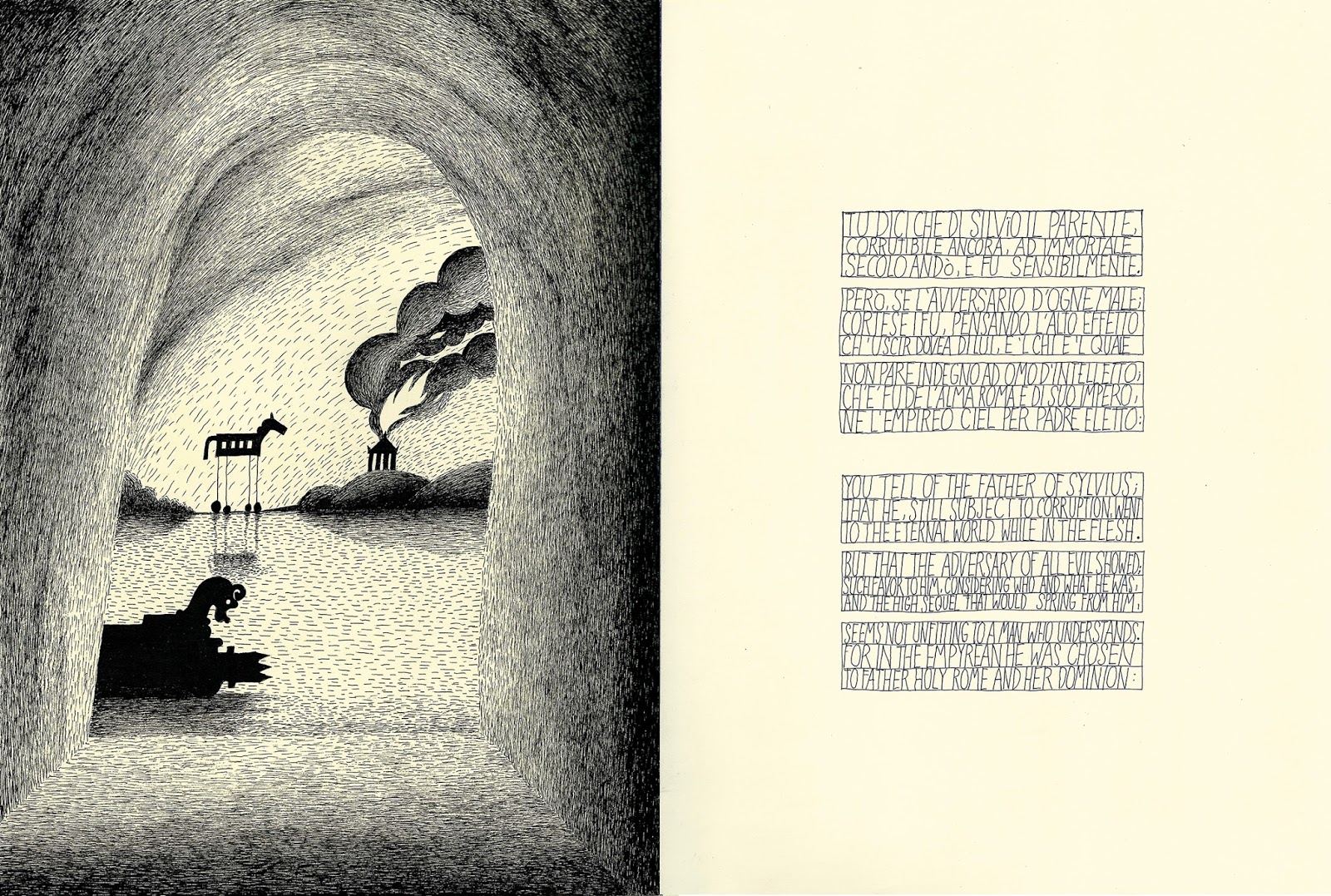
Inferno II: Aeneas Enters the Underworld


Inferno II: Aeneas Enters the Underworld
Ink on paper, 2016
22 x 15”


In the second canto, Dante asks his guide—the spirit of the Roman poet Virgil, author of The Aeneid—why he has been chosen to embark on such a formidable journey. He resists a comparison to Aeneas, who also ventured into the underworld.


*    *    *


The in the first canto of L'Inferno, Dante encounters Virgil, who explains to him the reputation of the beasts and the interaction between the two poets is one of the first instances of intertemporality, in which elements (in this case the two poets) from different times interact to convey a broader message. In La Commedia, Dante is both himself and Everyman, and he masterfully interweaves his true identity with that of mankind in a gripping tale of morality.

In the second canto, Dante balks at the comparison of himself and Aeneas, who entered the underworld at the bidding of his father in order to foresee the fate of Rome. Virgil is in many ways a paternal figure in the poem, and the analogy isn't hard to see. 

The drawing depicts a view from the entrance to the underworld, presumably from the perspective of Aeneas after his flight from the burning city of Troy. His ship (a bireme or trireme) is docked in the foreground and the city burns on the distant shore. This is one of the few drawings I have done that doesn't include a figure in service to the pictorial narrative. Perhaps this is for the sake of variety, but more likely it is done to avoid my cartoonish tendencies. If there's anything I wish to learn from this exercise it's the transcendence of levity in favor of darkness when it's appropriate. It's always been a struggle, this avoidance of humor in inappropriate circumstances. The lack of figuration may also be a natural way to detach from the immediate narrative a little. By showing a scene from a different time and space, and eliminating explicit reference to the narrators, I may see this as a sort of illustrated "cutaway," similar to the cinematic device used in film editing to denote parallel action.


Wednesday, January 18, 2017

Introduction to Inferno: Una Selva Oscura


Introduction to Inferno: Una Selva Oscura
Ink on paper. 2016
22 x 15”

In the opening canto of L’ Inferno, Dante finds himself in a dark wood (una selva oscura) having lost his way in life, both morally and intellectually. Thus begins the journey to Hell, Purgatory and Paradise, before returning to life a saved man.

*   *   *

For a couple of years, I taught a class with a brilliant RISD colleague—Mark Sherman, a medievalist in the Literary Arts and Studies Department. I learned a great deal from our experience, and particularly from Mark, who was not only a knowledgeable scholar but also a perfectly competent critic of visual communication. The class, "Illustrating Dante's Comedy," encouraged deeper reflection on the poem in its entirety, with the challenging premise of total immersion in both scholarly and studio investigation. We met for eight hours each week and talked constantly about the poem, its metaphorical and historical richness and how best to visualize it. I do think it was important for most of the students, as their apprehension of the content—written 700 years ago—was made more meaningful by their attempts at illustrating it, while their literary interpretation deepened their relationship to the content as artists. This was the goal, realized with exactitude through a huge investment of sweat and brain work.

It affected me too, and I remain grateful to Mark for resurrecting the poem for me. I don't think that any other teaching experience—at RISD or elsewhere—has more strongly influenced my own creative trajectory. I began by sketching in class as we discussed the poem and these little drawings eventually took shape as a project that's been consuming my attention for the past several months. Most of us read L'Inferno in high school or freshman lit classes in college, and its pulpy, phantasmal imagery appeals universally to youthful sensibilities. I last encountered L'Inferno (sans the rest of the poem) at age 19, my mind mired in newfound pleasures of freely available sex and beer and (finally, after 12 years of public school in which art class was shoved to the periphery) full-time dedication to art making. But in middle age I suspect the poem resonates more profoundly as it mirrors the preoccupations of people (like myself) whose paths in life are pondered with affection, regret, lost love, resentment and a desire to clarify, once and for all, the rest of the journey. Pick up Dante at age 50 and it will be a different literary experience. Spend many hours translating and drawing its tercets of terza rima and you'll realize how much you have in common with a 14th century poet, despite the hundreds of years and linguistic traditions that separate you.

I'm on sabbatical from teaching Illustration at RISD. My proposal, which was submitted in earnest many months ago, boldly (and with naive, puppy-dog enthusiasm, I will admit it) involved completion of 100 drawings based on La Commedia, an ambitious undertaking, to say the least. I've knocked a dent in it but I have a long way to go, of course. I still have time, and—as I near the ninth circle of hell in my efforts to illustrate this huge masterpiece—I'm probably about as intimidated as our hero was just before he encountered Lucifer, embedded in ice and chomping away on three sinners.

Recently (and I'm surprised that I never bothered to research this before) I took a look at relevant dates for the poem's creation. It took Dante, politically and socially exiled from Florence and couch surfing in other Italian cities, twelve years to complete the poem—from 1308-1320. He was, during its creation, between the ages of 43-and 55 years old. Coincidentally  (or perhaps not) at age 43 I came out to my kids, friends and colleagues after almost 20 years of marriage to a beautiful, wise and forgiving woman and found myself in a dark wood: una selva oscura. Desperate for jarring change and a fresh start, I moved to Rome to teach for RISD and enjoyed the departure from routine for two transformative years. This was certainly a momentous turning point in life and the beginning of a period of introspection and self-awareness that has culminated in innumerable life changes. During the past eleven years I have experienced a protracted awakening. I stopped drinking. I enjoyed a seven-year relationship with a man I met in Rome. I became vegetarian. I tried to steer my kids from harm as they teetered on the cusp of adulthood. I lost my mother, a beautiful force of nature, who passed away a month ago at age 96. I looked back on the countless mistakes and losses I experienced along the way. I became a more courageous man.

I'm not presumptuous enough to liken my own artistic pursuits to those of Dante, but I've been awed by the richness of experience this project has afforded me. I have undertaken it analogously, approaching each canto, from beginning to end, in the proper sequence. Like Dante, I begin in the dark wood, wondering how the hell I got here, grateful for so much but cursing myself for squandering some unusual gifts. The project has been deliberately structured as time-consuming (and occasionally maddening, especially when my own lack of resourcefulness or other obstacles slow me down). And, more than any other aspect of learning it has afforded me, I have been allowed to study my own processes—intellectual, formal and technical—and this is precisely what the gift of sabbatical is about. 

I'm including below the opening lines to L'Inferno, no doubt mirroring the experience of many of my brothers and sisters in mid-life, along with Henry Wadsworth Longfellow's 1867 translation:


Nel mezzo del cammin di nostra vita
mi ritrovai per una selva oscura,
ché la diritta via era smarrita.


Midway upon the journey of our life
I found myself within a forest dark,
For the straightforward pathway had been lost.

Sunday, September 29, 2013

EHP Poster Design

A poster designed for RISD's European Honors Program in Rome.


Wednesday, February 18, 2009

One of the coolest guys in Rome.


This accordionist is on Ponte Sisto just about every weekend morning, facing the sun, his body heaving to and fro to the music. He's completely rapt with pleasure while playing. I was finally able to get a photo of him.

Monday, September 8, 2008

Eight places. Wait, make that ten.

Gym
1:10
Treadmill, free weights.

Someone asked me recently to identify eight favorite meditative spots in Rome, places which might facilitate focused introspection and rejuvenation. I have to confess that I'm not really the silently meditative kind and I have a little trouble keeping still. While I regret this aspect of my personality, it comes with the territory, so there you go.

This doesn't mean I'm not a thoughtful person who seeks and finds inspiration in quiet reflection. I like to write when it's time to sort out my thoughts; and rather than finding answers in motionlessness, I tend to use the rhythm of walking, running or the systematic making of things to figure things out. I get a lot from physical experience. I guess I prefer a significant amount of sensory input when questioning things.

I confess that while I had hoped to collect a ton of photos myself for this travelogue, I haven't had time to shoot everything listed. So I'm filching some of these pictures from the internet and hoping they'll do justice to the promise of these places. I shot Piazza Mattei and the bottles in the river. The rest are the products of my thievery.

Eight places isn't a lot in a city as wonderful as Rome so I'm upping the ante to ten, in no particular order.

• The Pantheon.
It's a stone's throw from the apartment, and the Pantheon at any time of day is a great kick in the ass when you're feeling put upon in life. It's a truly phenomenal testament to the genius and resourcefulness of mankind and I challenge anyone to say "I can't" when considering this achievement. I sometimes bring a cup of coffee to the piazza and sit on the steps of the fountain in the morning, facing the temple. It's especially beautiful on a cool, cloudy morning in winter, when the gray color of the stone, the pavement, the sky—everything in sight—elide harmonically. At night, when the piazza is filled with exhausted tourists, the lights are beautiful.


Fontana dell'Acqua Paola.
While everyone else is clamoring for photo opportunities at the Trevi Fountain in the center, the Fontana dell'Acqua Paola on the Gianicolo offers a stunning vista of the city with a grand backdrop of gushing water, lit masterfully at night and cooling the atmosphere while the sun is high in the sky. Go at dusk and plan to spend a little time like the two-faced god Janus (after which Gianicolo was named), gazing out on the domes below and turning 180 degrees to watch the cascade. It's a bit of a walk (about a mile) from my place, but it's well worth the effort.


• Piazza Mattei.
Just outside the Jewish Ghetto (where you can observe some great neighborhood dynamics among young and old), this spot has two great things going for it: the Tartaruga fountain with four youths languidly reaching for Bernini-crafted turtles and a little place called Bartaruga. If you have the money to spend, get a glass of wine and sit outside. It helps if you have company (at least to split the bill). A couple of glasses of wine cost about €14, which is pretty high in my opinion, but you're paying for the atmosphere. The interior of the bar is pretty kitsch, but very comfortable with an opportunity for intimate conversation and the people inside are very nice.


• San Luigi dei Francesi.
Near the Pantheon (with your back to the Pantheon turn left at the far end of the piazza) San Luigi dei Francesi is the parish of the French Catholic community in Rome. The exterior could use a good cleaning, but perfection awaits inside. The last chapel on the left holds three large Caravaggio paintings chronicling the story of St. Matthew. It's always crowded but well worth the visit.


• Santa Maria del Popolo.
In Piazza Del Popolo another pair of Caravaggio's—The Crucifixion of St. Peter and the Conversion of Paul—are free for the looking at Santa Maria del Popolo. It's not always easy to sit in silent meditation of these paintings. A good long look, however, followed by some quiet reflection in the church, is very rewarding.


• The Ecstasy of St. Teresa, Santa Maria della Vittoria.
This is far enough away from the center to be a little less populated by tourists, so I think it's worth the hike. And unlike the Caravaggio paintings you can sit to face the sculpture head on.


• Temple of Aesculapius, Villa Borghese.
This is a 19th century folly, not a true temple, but it's a nice place to sit and read, think, write or draw. The park is also a great place to run and the Galleria Borghese holds a lot of fantastic art.


• A Walk Across the Bridges
Begin in the morning or as the sun begins to fade with Ponte Fabricio, the oldest bridge in Rome. Make your way to the Trastevere side after crossing Isola Tiberina (the island). Turning right on the other side, you'll reach Ponte Garibaldi which you'll cross back to the other side. It's worth a stop on Ponte Garibaldi to behold the mesmerizing dance of the recyclables in the falls below the bridge. Don't miss this strangely beautiful phenomenon. Repeat this zig-zag pattern until you reach Pont Saint Angelo, with Bernini's angels flanking each side, and then head back. Some mornings around 9:00, on Ponte Sisto, you'll find the most emotionally demonstrative accordionist in the city. He's a little Asian man who faces the sun with his eyes closed, his entire body swaying with the music as he plays. And he can really play with sincerity and emotion, unlike a lot of the clowns who make money in the center.


• The Protestant Cemetery
Behind the old city wall and spilling out of the base of the Pyramid is the Protestant Cemetery, the burial place of non-Catholics and foreigners in Rome. Shelley and Keats are buried here and it's a remarkably peaceful place whose walls keep the din of the city at bay. There are plenty of places to sit and you can wander for a couple of hours from row to row in search of interesting lives which have passed through Rome over the centuries.


• The Palatine Hill at Sunset.
From the top of the hill at Piazzale Ugo di Malfa (the crest of the long hill running along the south side of Circo Massimo), take in the ruins of the Palatine on the other side of the field. At sunset, the warm bricks and austere arches and towers are really beautiful, and you can really gain a sense of the privileged vantage point of the aristocracy in Ancient Rome, when chariots raced in the Circo below.


• Bonus Spot.
If all else fails light the torches on our lower terrace at night and sit at the table. Looming above, you'll see the remains of the great round entrance hall of the Baths of Agrippa, constructed in about 19 BC. The past, and Rome has plenty of it, gives pause to present concerns.

Friday, August 29, 2008

A very old bridge.


Running
3.7 miles in 29:43 (8:01 per mile)

I really enjoy running at night in Rome. The city is cooler, the lights are beautiful and there are fewer cars and people on the streets to block my way. I did a zig-zag out and back over the bridges, beginning with Ponte Garibaldi and traveling north to Pont St. Angelo. The race is in two days and the night running is probably good practice, albeit a little late.

I spent the late afternoon collecting photos of some of my favorite places, one of which is the oldest bridge in Rome—Ponte Fabricius, built in 62 BC. Imagine the history that's trod across that bridge.

On the Campus Martius side of the bridge there are a couple of badly eroded Janus heads, which were installed in the 14th century. What a place this is. I'll surely miss it when I have to return home to shopping centers and driving wherever I want to go.