Showing posts with label history. Show all posts

Saturday, November 11, 2017

Inferno XXI: "He made a trumpet of his rump."


Inferno XXI: The Malebranche
Ink on paper, 2016
22 x 15”

In the fifth ditch (or malebolgia) of the eighth circle of Inferno, Dante and Virgil are immersed in tarry darkness, which—while unnerving—provides cover from a comically furious band of nine demons known as the Malebranche. Hidden behind the rocks, Dante is eventually revealed when Virgil addresses the rowdy brood. They threaten to attack but are stopped by Malacoda, their leader, as he engages Virgil in conversation, and even offers to accompany our heroes on the next leg of their journey. Much excitement ensues and their leader releases an explosive burst of gas from his butt or, in Dante's words, "ed elli avea del cul fatto trombetta" (he made a trumpet of his rump):


Per l’argine sinistro volta dienno;
ma prima avea ciascun la lingua stretta
coi denti, verso lor duca, per cenno;
ed elli avea del cul fatto trombetta.

They wheeled about along the left dike,
but not before each had thrust his tongue between 
his teeth in signal to their leader;
and he made a trumpet of his rump.

*    *    *

I grew up in a politically liberal yet sexually repressive household. My father and mother were born in 1918 and 1920, respectively, and I never saw them display affection with enjoyment or abandon. My father would arrive home from work at 5:00pm, and meet my mother in the kitchen. She would greet him cheerfully, and as their lips would touch, his gaze would meet mine with a furtive look of embarrassment, or even panic. When we watched the Jackie Gleason Show, with its sexy chorus girls in skimpy costumes, my dad would mutter "nothing but bums, all of them." He was fearful and disdainful of all things carnal, as was my mother, who was raised in a superstitious, Irish-Catholic household in Boston, with the remnants of 19th century moral codes guiding her conscience ("Marguerite, you know that the Blessed Mother frowns on little girls who whistle"). She squelched my own sexual expression early on in life (without revealing too much here's a snapshot: little boy, boner, bed) with a fierce glare.

I am always impressed and a little surprised when I encounter Canto XXI of L'Inferno, wherein the pious Dante delivers with gusto the imagery from the passage above. His delight in vulgarity is infectious, even if he disguises it by presenting it as the shameful product of a marauding band of demons. The plain truth is that Dante periodically indulges in vulgar bits of narrative, just as Chaucer did several decades later in The Canterbury Tales. Here's an excerpt from The Miller's Tale:

This Nicholas just then let fly a fart
As loud as it had been a thunder-clap,
And well-nigh blinded Absalom, poor chap;
But he was ready with his iron hot

And Nicholas right in the arse he got.

It's a dirty shame that things which come naturally to us as a species—the smelly, comically sonic marvels of flatulence, the unbridled enjoyment of animalistic sexual encounter, naughty delight in a dirty joke, unbridled promiscuity, empowerment to identify our own gender and sexual orientation —are arbitrarily relegated to the shadows of sin. Less than 500 years ago our carnal nature was factual. It was expected of us. We reveled in it. Michel Foucault wrote extensively on the subject of changing sexual mores and the first volume of his History of Sexuality begins with a bang: 

“At the beginning of the seventeenth century a certain frankness was still common, it would seem. Sexual practices had little need of secrecy; words were said without undue reticence, and things were done without too much concealment; one had a tolerant familiarity with the illicit. Codes regulating the coarse, the obscene, and the indecent were quite lax compared to those of the nineteenth century. It was a time of direct gestures, shameless discourse, and open transgressions, when anatomies were shown and intermingled at will, and knowing children hung about amid the laughter of adults: it was a period when bodies “made a display of themselves.”

Reading Dante offers a glimpse of humanity's relationship with the illicit in medieval times, underscoring the notion that, whatever our proclivities or indulgences, we were born this way.

Wednesday, August 9, 2017

Inferno XIX: Comeuppance.


Inferno XIX: The Simonists
Ink on paper, 2016
22 x 15”

Our heroes have arrived at the lip of the third bolgia in the eighth circle of hell. Looking across the expanse of stone, they see spirits buried upside down in holes in the ground—dozens of legs kicking spasmodically as the soles of their feet are licked by oily flames. They are, no doubt, very uncomfortable, having been shoved head first into stone. These are the simonists, people who used ecclesiastical positions of power for personal gain, and among them is a particularly noteworthy offender.

*    *    *

"Sometimes, when I lack the motivation to get out of bed and start the day, I remember revenge..."

Thus spake a particularly witty friend on Facebook last week, delighting me with his self-mocking spitefulness. I'm happy to boast that I'm not a vindictive person, but I do love a good tale of revenge in film and literature. Farrah Fawcett in Extremities, imprisoning her vile attacker in a fireplace. Hansel and Gretel, giving the momentarily clueless witch a run for her money into a blazing oven. Hamlet, hell-bent and psychotically obsessed with avenging his father's fratricide. And of course, there's Steven King's Carrie, launching a blazing, telekinetic massacre in a high school gym while drenched on stage in pig's blood. You go, girl.

Dante sometimes seems all about retribution, and—like many before and after him—he deftly utilizes narrative fiction to skewer his nemeses, wresting complete control in life's infinite power struggle by indulging himself and his reader in wicked comeuppance for transgressors. Dante delights in the imaginary punishment of his contemporaries by an omnipotent God, and their humiliation is made all the more public in the incremental distribution of his poem to the populace.

It's no coincidence that the simonists are buried in holes that resemble baptismal fonts. This instrument of purification and rebirth is perfectly suited to Dante's exquisite irony, and the lead recipient of this punishment is none other than Pope Nicholas III, who foreshadows the eventual arrival of (in Dante's eyes) an even more deserving papal cad—Pope Bonafice, the political leader of the Black Guelphs, the group that banished Dante from his beloved Florence. 

Comeuppance is a word perfectly suited for the concept of exacted revenge, and Dante masterfully guides it in Canto XIX, as things are turned around, over and upside down with cruel yet delightful irony. 

Friday, April 7, 2017

Inferno XVII: The Face of A Just Man


Inferno XVII: The Face of A Just Man
Ink on paper, 2016
22 x 15”

In this canto, Dante and Virgil meet Geryon, the winged monster of fraud, who rises from the abyss to transport them downward, from the edge of towering cliffs to the eighth circle of Inferno.


*    *    *

Geryon is an ancient mythic character whose early appearance in Greek myth bears little resemblance to the 14th century monster Dante created for Canto XVII of L’Inferno. Often freely transforming characters from history and literature (King Minos of Crete, for example, in Canto V, is transmogrified into a beastly guardian of hell with a serpent’s tail) Dante’s poetic license never fails to deliver with absolute potency the moral lessons he most wants to convey. And, truth be told, it’s easy to accept that once a character enters the underworld, just about anything can happen. Kings grow tails and mythic Greek monsters change costume.

The story is about to dedicate itself to the world of sins collectively known as fraud, a particularly detestable offense in Dante’s estimation. The eighth circle features the Malebolge, a sequence of ten ditches wherein fester perpetrators of all classes of fraud: panderers and seducers; flatterers, simoniacs (those who sold ecclesiastical favors); sorcerers; barrators (corrupt politicians); hypocrites; thieves; counsellors of fraud; sowers of discord; and falsifiers.

Geryon is described as the “foul effigy of fraud,” and this is expressed in his chimeric corporeality: he has a reptilian body, lavishly decorated and resembling a middle-eastern carpet. His arms are hairy and a deadly scorpion’s tail is concealed at the end of his enormous body. But his most fraudulent attribute is his deceptive visage: “the face of a just man.” 

Throughout La Commedia, Dante integrates significant use of the number three in imagery, structure and narrative. Robert Hollander brilliantly discusses Geryon as one of the most cleverly crafted metaphors of the poem: “This embodiment of fraud is thus presented as the counterfeit of Christ, three-in-one rather than one-in-three.”

I really loved making this drawing—the scale of the monster is extremely exaggerated in my conception, much bigger than I’ve seen him represented in the precedents I researched. And, on a technical note, somehow the pen behaved itself (for once) and I was able to pull it off to my satisfaction.

Monday, March 6, 2017

Inferno XIV: The Old Man of Crete


Inferno XIV: The Old Man of Crete
Ink on paper, 2016
22 x 15”

A fantastic interlude occurs in the fourteenth canto of L’Inferno as Virgil revives imagery from Nebuchadnezzar’s Dream, an image of a giant statue made from various materials, from precious and strong on the top to crumbling clay at the bottom.

*    *    *

After leaving the Forest of Suicides Dante and Virgil traverse the burning sands of the the seventh circle of hell. Their conversation is set aside for a time as Virgil relates the allegory of the Old Man of Crete, an image borrowed from the second chapter of the Book of Daniel, in which the great King Nebudchadnezzar is visited by a dream of a giant statue, metaphorically composed of various materials—strong to weak, precious to worthless. In Virgil’s description the statue is an enormous colossus, emerging from the side of Mount Ida in Crete. 

The statue’s back faces Egypt, heretofore the world’s dominant society, and looks to Rome in deference to Christian rule. As a symbol of humanity’s crumbling moral and political fortitude it has a head of gold, arms and breast made of silver, bronze abdomen and thighs, and iron legs. His right foot, upon which he rests most of his weight, is made of crumbling, kiln baked clay, a symbol of the deteriorating institution of the medieval Catholic Church. He cries tears (through cracks in his body, not as I have depicted it in the illustration) which on the ground below create the four rivers of Inferno: Acheron, Styx, Phlegethon and Cocytus. 


This is my favorite drawing so far, in part because of the sheer complexity of the image I needed to make. I relied a bit on ancient conceptions of Nebudchadnezzar is developing the costume and styling of hair and beard (see below), and really enjoyed interpreting the various active aspects of the image, finding concise and iconic ways to indicate is gaze, the tears, the geography, and materiality.


Saturday, February 18, 2017

Inferno XIII: The Forest of Suicides


Inferno XIII: The Forest of Suicides
Ink on paper, 2016
22 x 15”

In the second ring of the seventh circle of hell, Virgil encourages Dante to pluck a twig from a thorn tree. Our hero is shocked to discover that the tree is an unnamed suicide, whose plaintive cries and oozing black blood reveal the collective fate of the entire forest.


*    *    *

As Dante and Virgil enter the second of three rings in the Circle of the Violent, they encounter the fate of those who do violence to themselves. Disembodied moans surround them and Virgil tells Dante that if he were to pluck a twig from one of the mangled trees, he might learn the story.

Dante does so, and—weeping with despair and oozing black blood—the tree ultimately unravels his story. He walked the earth as Pier della Vigna, counselor to the Emperor Frederick II. Vigna’s fated suicide was in a strange way the result of his fierce dedication and love for Frederick. His contemporaries grew envious of their close relationship and they circulated ugly rumors, causing him great shame, despair and—ultimately—death by his own hand.


In search of a different language for this drawing, I’ve developed something more of a design. 

Tuesday, February 7, 2017

Inferno X: Farinata degli Uberti


Inferno X: Farinata degli Uberti
Ink on paper, 2016
22 x 15”

In one of the most theatrical and haunting moments of L'Inferno, Dante is recognized by Farinata degli Uberti, a Florentine military leader and politician. In passing an expanse of flaming sarcophagi, Dante is stopped by the voice of a fellow Florentine, who recognizes his Tuscan accent. The two have a little chat about Florence, their families and honor.

*    *    *

In the sixth circle of Hell, we meet two of the heretics damned to remain there, including Farinata, whose family feuded with Dante's in Florence. Farinata recognizes Dante's Tuscan accent and, rising eerily from his sarcophagus, he engages him in debate about the honor of their respective families. 

Early on, in the Gates of Hell illustration, I first integrated an iconic reference to Florence in the fleur-de-lis, and I've attempted to revive it here in the silhouette created by Farinata's figure and the flames bursting from all sides of his body as he rises from the grave. Additionally, much has been made of the imagery Dante evokes in Farinata's pose. Seen from the waist up he has reminded many a scholar of the Man of Sorrows, a trope of the newly resurrected Christ, displaying the wounds of crucifixion with profound grief. In this image, Christ is represented as both dead (as man) and alive (as God).


Thursday, February 2, 2017

Inferno IX: The Furies at the Gates of Dis


Inferno IX: The Furies at the Gates of Dis
Ink on paper, 2016
22 x 15”


Arriving at the gates of the city of Dis, Dante and Virgil are accosted by three furies, minions of Medusa. 

*    *    *

Dante and Virgil meet some formidable foes in the furies, Greek figures of vengeance with bat wings and snakes for hair, who carried instruments of torture and punishment: a whip, a chalice of poison and a torch. They hover at the gates of Dis, a walled city whose architecture included mosques (presumably inspired by Jerusalem of the 14th century). Because Islam was a relatively new religion—considered heresy in the eyes of the Church and was certainly not Christianity—its monuments were fitting features of a city whose primary descriptive elements contradict conceptions of Paradiso.


Inferno VIII: "Seize Filippo Argenti!"


Inferno VIII: "Seize Filippo Argenti!"
Ink on paper, 2016
22 x 15”

Dante encounters the Florentine politician Filippo Argenti, and the wrathful cease their violent battle to consolidate their attacks on him. Argenti then begins to tear at himself in due course, making quite a bloody scene.


*    *    *

The wrathful turn on Filippo Argenti, but he literally beats them to the punch, tearing at his own flesh in a frenzy. In Bocaccio's Decameron, Argenti's ire is raised by a practical joke played by Ciacco,  It's been said that Filippo Argenti once slapped Dante, that his brother had claimed Dante's possessions after his exile, and that the whole Argenti family opposed Dante's return. Dante held some pretty big grudges and the Hollanders explain the character in this gloss from their edition of L'Inferno.

“From the cries of others the reader finally learns the name of this sinner (Dante has known exactly who he is—see v. 39). Filippo Argenti was a Black Guelph from a powerful Florentine family. His real name was Filippo Adimari de’ Cavicciuoli, but he supposedly was known as Filippo Argenti because he had his horse’s hooves shod in silver (argento). A number of early commentators relate that his brother, Boccaccino, got hold of Dante’s possessions when the poet was exiled. If that is true, we have here a pretty clear case of authorial revenge upon a particularly hated enemy. See Francesco Forti, “Filippo Argenti,” ED, vol. 2, 1970, pp. 873–76.”

Excerpt From: Dante, Robert Hollander & Jean Hollander. “The Inferno.” 

Wednesday, February 1, 2017

Inferno VII: The Wrathful Smite Each Other in the River Styx


Inferno VII: The Wrathful Smite Each Other in the River Styx
Ink on paper, 2016
22 x 15”

Canto seven includes a scene of great ferocity, as those whose anger and spiteful nature guided them in life are condemned to beat, kick and bite one another while floating in the River Styx.

*    *    *

Dante had a ferocious sense of humor and this is evidenced throughout L'Inferno, wherein he subjects friend and foe alike to dreadful fates—punishments ranging from the inconvenient to the inhumane. He reserved a great deal of his ire for political rivals who are eternally tortured, burned and humiliated in the bowels of Hell. And, while he pitied the misfortune of the timing, he added historical figures who (sometimes merely because they were born before Christianity was in flower) were doomed to lives of boredom, aimlessness or shame. 

In one of my favorite scenes, dozens of furious souls are damned to partake in a raging battle in the bloody River Styx in Canto Seven. Arriving on the scene he sees all manner of chaos and carnage happening among the participants—an angry, mud-soaked mob immersed in the bloody waters, biting, kicking, drowning, punching and slapping each other. 

And yet, somehow this scene carries with it a terrific sense of absurdity, and it's tough to explain why. I suppose the very notion of people immersed in blood, attacking one another with utter malice is terrifying, but somehow it's worth a chuckle:


In la palude va c’ha nome Stige
questo tristo ruscel, quand’ è disceso
al piè de le maligne piagge grige.

E io, che di mirare stava inteso,
vidi genti fangose in quel pantano,
ignude tutte, con sembiante offeso.

Queste si percotean non pur con mano,
ma con la testa e col petto e coi piedi,
troncandosi co’ denti a brano a brano.

_____________________________

It becomes a swamp by the name of Styx,
this sorry brook, when it descends
at the foot of the malignant, grey shore.

And I, who stood intent,
saw muddy people in the quagmire,
all of them naked and inflamed.

They struck each other not only with their
hands, but with their heads, breasts and feet,
and tore each other piece by piece with their teeth.


For me, head butts are entirely reminiscent of the theatrical absurdity of pro wrestling, and Dante's refined and shocked countenance adds a bit more to the spectacle. 

Sunday, January 29, 2017

Inferno V: King Minos, The Adjudicator


Inferno V: King Minos, The Adjudicator
Ink on paper, 2016
22 x 15”

The dead line up to confess their sins to King Minos, who encircles himself with his serpentine tail, the number of times it girds his body corresponding directly to the circle of hell to which each soul is destined. The Prince of the Lilies, from Knossos on Crete, served as inspiration for the costuming.

*    *    *

In one of the most unnerving moments of L'Inferno, Dante and Virgil observe King Minos holding court over countless souls who must report to him their transgressions before he can damn them to the appropriate circle of Hell. Dante often indulges in generous poetic license to re-imagine characters from myth and history, and his chimeric mutation of Minos from ancient Greek King to serpentine monster is one of his most colorful and sinister characterizations.

The Prince of the Lilies, a fresco unearthed at Minos' infamous Knossos palace (where beneath the floors lurked another hybrid beast, the Minotaur) gave me a great head start in imagining the adjudicator's flair for elaborate, peacock-and-lilies headdress and long, wavy locks.

Saturday, January 28, 2017

Inferno IV: The Great Poets


Inferno IV: The Great Poets
Ink on paper, 2016
22 x 15”

In esteemed and honorable company, Dante is invited to walk alongside the shades of four ancient poets, thereby placing himself among giants of verse, but slyly doing so in the guise of fictional narrative. Here he meets Homer, Horace, Ovid and Lucan, all wandering expressionless in Limbo.

*    *    *

After the "Gates of Hell" drawing (27 January), I realized that I was setting a stylistic and technical precedent that would be tough to live up to in the time I had allowed to finish the project. Creating so much density and complexity with a 00 Rapidograph pen would be tough. So, I took a gamble and developed an image of the four poets which was much lighter in tone. My hope was that the delicate lines would adequately express the spectral nature of these four shades. I pick up the lighter treatment again later, and I'm pretty pleased with the unity of the series. In fact, I'm glad I did this, because the shifting qualities of each—while related to the others—provides a little variety in the sequence.

The encounter described in Canto IV displays Dante's considerable ego and false humility in full flower. Staging a fraternal invitation by four of the greatest poets to have ever walked the earth was a pretty convenient way to exalt his own status as a living poet, all the while humbling himself by proclaiming his unworthiness. 


Friday, January 27, 2017

Inferno III: The Gates of Hell


Inferno III: The Gates of Hell
Ink on paper, 2016
22 x 15”


Dante and Virgil soon arrive at the Gates of Hell, whose forboding inscription reads “Abandon All Hope, You Who Enter Here.”


*    *    *

Dante struggled with deeply conflicted feelings about his native city, Florence. Exiled in 1301 because of his affiliation with a political faction known as the White Guelphs, he spent the next several years traveling and writing, his chief accomplishment being La Commedia.

The symbol of Florence for many centuries has been the fleur-di -lis, and in depicting his arrival with Virgil at the entrance to l'Inferno, I wanted primarily to do two things: emphasize the scale of Hell's formidable architecture and—perhaps more importantly—investigate whether some analogous relationship could be forged with Florence. I have incorporated the fleur-di-lis in many places in the series, and this is its first appearance (in the ornamentation on the pyramidal part of the structure on top).

Incidentally, the stepped pyramid above the inscription is a deliberate foreshadowing to the Purgatorial mountain, whose seven levels Dante must ascend in Purgatorio, before reaching Paradise and his beloved Beatrice.

Wednesday, January 25, 2017

Inferno II: Aeneas Enters the Underworld


Inferno II: Aeneas Enters the Underworld
Ink on paper, 2016
22 x 15”


In the second canto, Dante asks his guide—the spirit of the Roman poet Virgil, author of The Aeneid—why he has been chosen to embark on such a formidable journey. He resists a comparison to Aeneas, who also ventured into the underworld.


*    *    *


The in the first canto of L'Inferno, Dante encounters Virgil, who explains to him the reputation of the beasts and the interaction between the two poets is one of the first instances of intertemporality, in which elements (in this case the two poets) from different times interact to convey a broader message. In La Commedia, Dante is both himself and Everyman, and he masterfully interweaves his true identity with that of mankind in a gripping tale of morality.

In the second canto, Dante balks at the comparison of himself and Aeneas, who entered the underworld at the bidding of his father in order to foresee the fate of Rome. Virgil is in many ways a paternal figure in the poem, and the analogy isn't hard to see. 

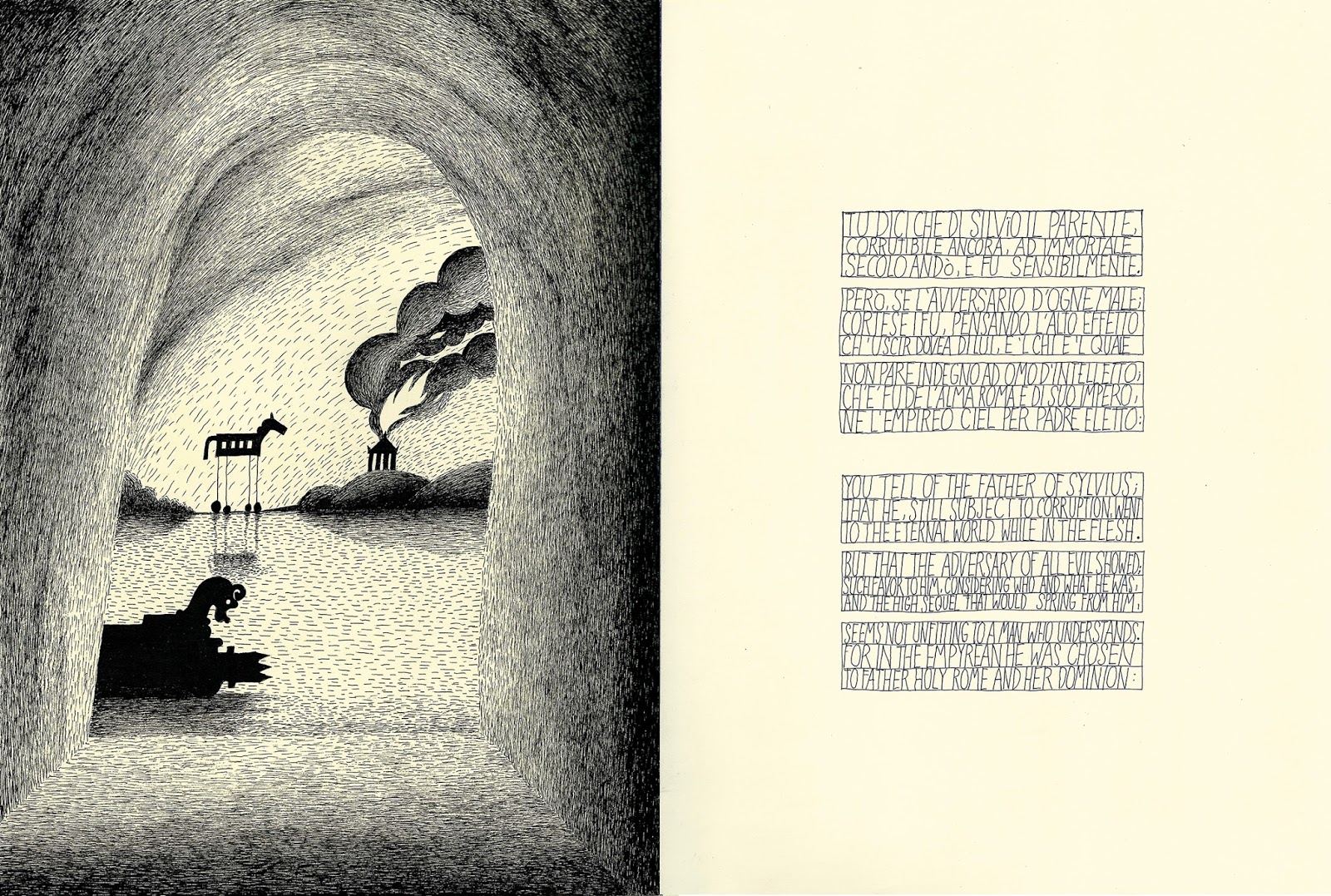
The drawing depicts a view from the entrance to the underworld, presumably from the perspective of Aeneas after his flight from the burning city of Troy. His ship (a bireme or trireme) is docked in the foreground and the city burns on the distant shore. This is one of the few drawings I have done that doesn't include a figure in service to the pictorial narrative. Perhaps this is for the sake of variety, but more likely it is done to avoid my cartoonish tendencies. If there's anything I wish to learn from this exercise it's the transcendence of levity in favor of darkness when it's appropriate. It's always been a struggle, this avoidance of humor in inappropriate circumstances. The lack of figuration may also be a natural way to detach from the immediate narrative a little. By showing a scene from a different time and space, and eliminating explicit reference to the narrators, I may see this as a sort of illustrated "cutaway," similar to the cinematic device used in film editing to denote parallel action.


Friday, January 20, 2017

Inferno I: The Three Beasts


Inferno I: The Three Beasts
Ink on paper, 2016
22 x 15”


As he begins his journey, Dante is three times turned back for fear of attack by three wild beasts: a leopard (representing lust), a lion (pride) and a she-wolf (avarice).

*   *   *

What began as my favorite Inferno image in my sketchbook—indeed, the one that kicked off the project in an exciting way for me—has lately haunted me in its lack of sophistication and gravitas since I committed it to larger scale. I drew this spread no less than five times before arriving at this version and I'm intent on developing an improved iteration, once the whole series is finished and I have time to backtrack and fix things. It's driving me nuts. It's too playful and disarming.

Providing narrative context is important if one is to understand the relevance of Dante's encounter with the leopard, lion and she-wolf, set early in the poem, shortly after Dante awakens in the forest, filled with regret and fear. As he makes his way through the landscape, he encounters three savage beasts. In almost all scholars' minds, these animals represent three grave sins of man, but there's sometimes disagreement about which transgressions they are. 

I'm most familiar with the edition of La Commedia that was translated and glossed by Robert and Jean Hollander in 2000. They eloquently discuss the animal metaphors in their notes:

“The early commentators are strikingly in accord; for them the beasts signify (1) three of the seven mortal sins: lust, pride, and avarice. Modern interpreters mainly—but not entirely, as we shall see—reject this formulation. One of these interpretations is based on Inferno VI. 75, the three “sparks” that have lit evil fires in the hearts of contemporary Florentines, according to Ciacco, who is seconded by Brunetto Latini [Inf. XV. 68]): (2) envy, pride, and avarice. Others suggest that the key is found at Inferno XI. 81–82, where, describing the organization of the punishment of sin, Virgil speaks of (3) “the three dispositions Heaven opposes, incontinence, malice, and mad brutishness.” Even within this approach there are strong disagreements as to which beast represents which Aristote-lian/Ciceronian category of sin: is the leopard fraud or incontinence? is the she-wolf incontinence or fraud? (the lion is seen by all those of this “school” as violence). For instance, some have asked, if the leopard is fraud, the worst of the three dispositions to sin, why is it the beast that troubles Dante the least? A possible answer is that fraud is the disposition least present in Dante.”

Excerpt From: Dante, Robert Hollander & Jean Hollander. “The Inferno.” iBooks. https://itun.es/us/sBENE.l

I would be perfectly content if scholars could reach some consensus on these interpretations, if only for my stumbling on the convenient formal metaphor that associates the leopard's camouflage with the concept of "fraud." Nothing's easy in hell.