
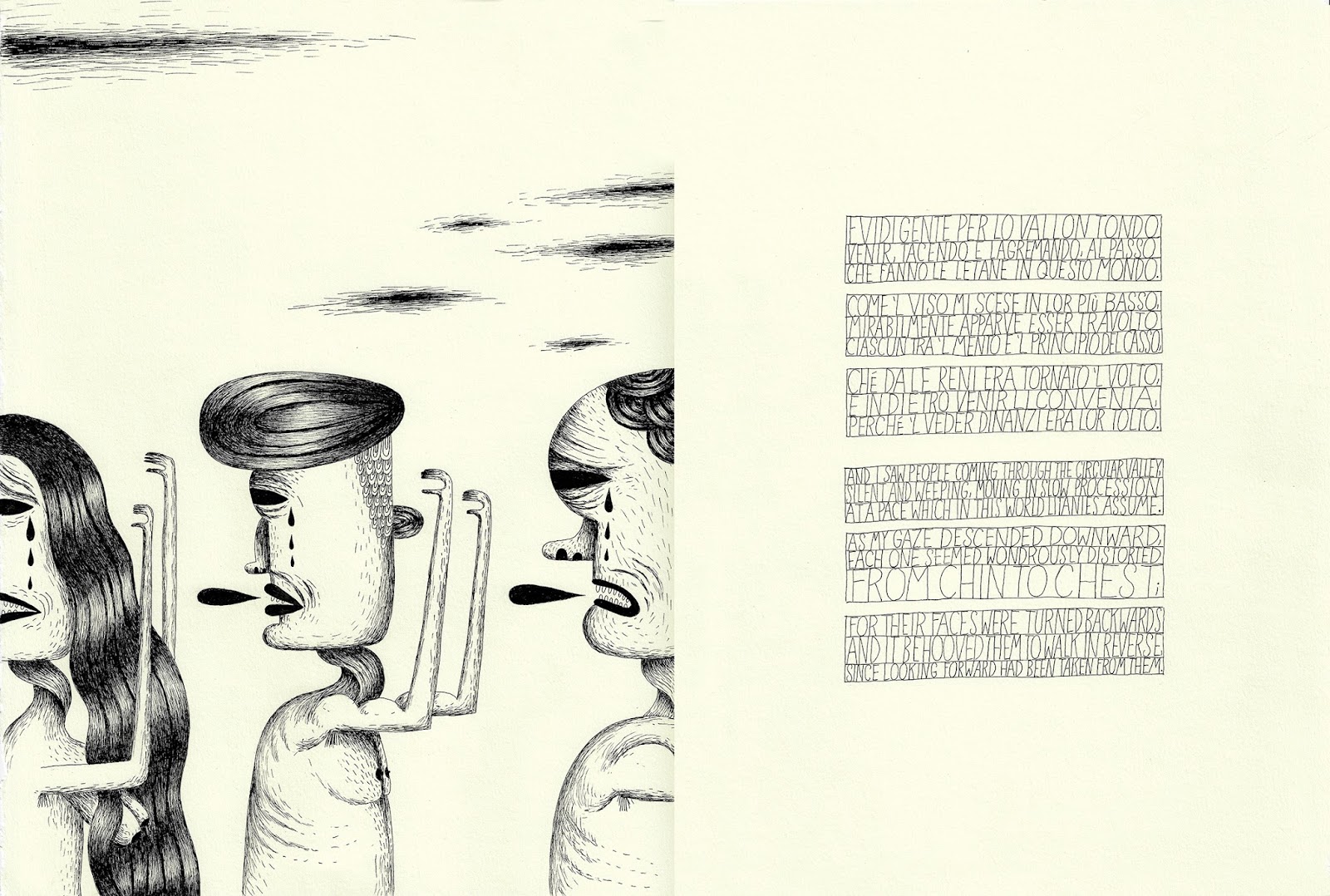
Inferno XX: The Diviners
Ink on paper, 2016
22 x 15”
Dante arrives at a chasm which is "bathed in tears of agony," and beholds a gloomy, glacial procession of sinners. These are the diviners: magicians, soothsayers, fortune tellers, and military strategists who dared predict the future. Their perverse punishment is to possess a single mode of expression—incessant tears—while walking backwards with their heads twisted around.
* * *
We live where our attention is. When we direct our attention fully to the present moment, we are fully alive. —Eknath Easwaran
The medieval church considered divination a form of heresy, usurping the omniscience of God as the sole author of fate. Dante's diviners are an absurd brood, weeping in an excruciatingly slow procession while walking backwards, with their heads twisted 180º to enable them to see where they are going.
I'm the least qualified person to discourse on present mindfulness. A consummate worrier, I've nevertheless made an effort, but failed, to "live in the present" over the years. Sure, I believe that the future is not yet a reality and the past cannot be changed, but I spend a lot of time wondering how the consequences of my past idiocy will haunt me in the future.
For years I had a couple of anxiety dreams about the future. One dream was so exquisitely metaphorical that I actually cherished it when it recurred several times, even though it terrified me when it inhabited my sleep. It involved a tornado on the distant horizon, a sure sign of impending doom and destruction. Sometimes I was in a car, and other times I was in some sort of structure—a glass skyscraper, a house, looking out a kitchen window. In each instance I was engrossed in some conversation or some other activity involving other people when my attention would be drawn to the window. Looking out, I would catch sight of the ominous ribbon of black dust and debris, always on the horizon (it had to remain there—otherwise it would be about the present). I would always wake before it tore my life apart.
The second dream was also a recurring narrative that haunted my sleep. It was much more disturbing than the tornado dream, and seemed to be as much about the past as it was about the future. I would find myself in a deep pit somewhere, unable to get out and eventually made aware that I was in the grave with someone I had killed, albeit accidentally. Panic would inevitably ensue when I realized that the body would soon be buried by others, whose voices I could hear approaching from the landscape above. I would soon be discovered and punished, a victim of my own transgressions.
I haven't had either of these dreams for many years, and I do think they stopped around the time that I came out to my kids and separated from the wonderful woman to whom I was married for 20 years. No more fear of consequences for that horrific, unintended crime (which was a metaphor for the secrets I was keeping, I'm sure). To this day, when I reflect on the realism of that dream, I have to remind myself that I'd never harm a fly, and that my future no longer includes fear of being outed as a metaphorical murderer.
We live where our attention is. When we direct our attention fully to the present moment, we are fully alive. —Eknath Easwaran
The medieval church considered divination a form of heresy, usurping the omniscience of God as the sole author of fate. Dante's diviners are an absurd brood, weeping in an excruciatingly slow procession while walking backwards, with their heads twisted 180º to enable them to see where they are going.
I'm the least qualified person to discourse on present mindfulness. A consummate worrier, I've nevertheless made an effort, but failed, to "live in the present" over the years. Sure, I believe that the future is not yet a reality and the past cannot be changed, but I spend a lot of time wondering how the consequences of my past idiocy will haunt me in the future.
For years I had a couple of anxiety dreams about the future. One dream was so exquisitely metaphorical that I actually cherished it when it recurred several times, even though it terrified me when it inhabited my sleep. It involved a tornado on the distant horizon, a sure sign of impending doom and destruction. Sometimes I was in a car, and other times I was in some sort of structure—a glass skyscraper, a house, looking out a kitchen window. In each instance I was engrossed in some conversation or some other activity involving other people when my attention would be drawn to the window. Looking out, I would catch sight of the ominous ribbon of black dust and debris, always on the horizon (it had to remain there—otherwise it would be about the present). I would always wake before it tore my life apart.
The second dream was also a recurring narrative that haunted my sleep. It was much more disturbing than the tornado dream, and seemed to be as much about the past as it was about the future. I would find myself in a deep pit somewhere, unable to get out and eventually made aware that I was in the grave with someone I had killed, albeit accidentally. Panic would inevitably ensue when I realized that the body would soon be buried by others, whose voices I could hear approaching from the landscape above. I would soon be discovered and punished, a victim of my own transgressions.
I haven't had either of these dreams for many years, and I do think they stopped around the time that I came out to my kids and separated from the wonderful woman to whom I was married for 20 years. No more fear of consequences for that horrific, unintended crime (which was a metaphor for the secrets I was keeping, I'm sure). To this day, when I reflect on the realism of that dream, I have to remind myself that I'd never harm a fly, and that my future no longer includes fear of being outed as a metaphorical murderer.


 Posts
Posts


