Showing posts with label gay. Show all posts

Thursday, November 9, 2017

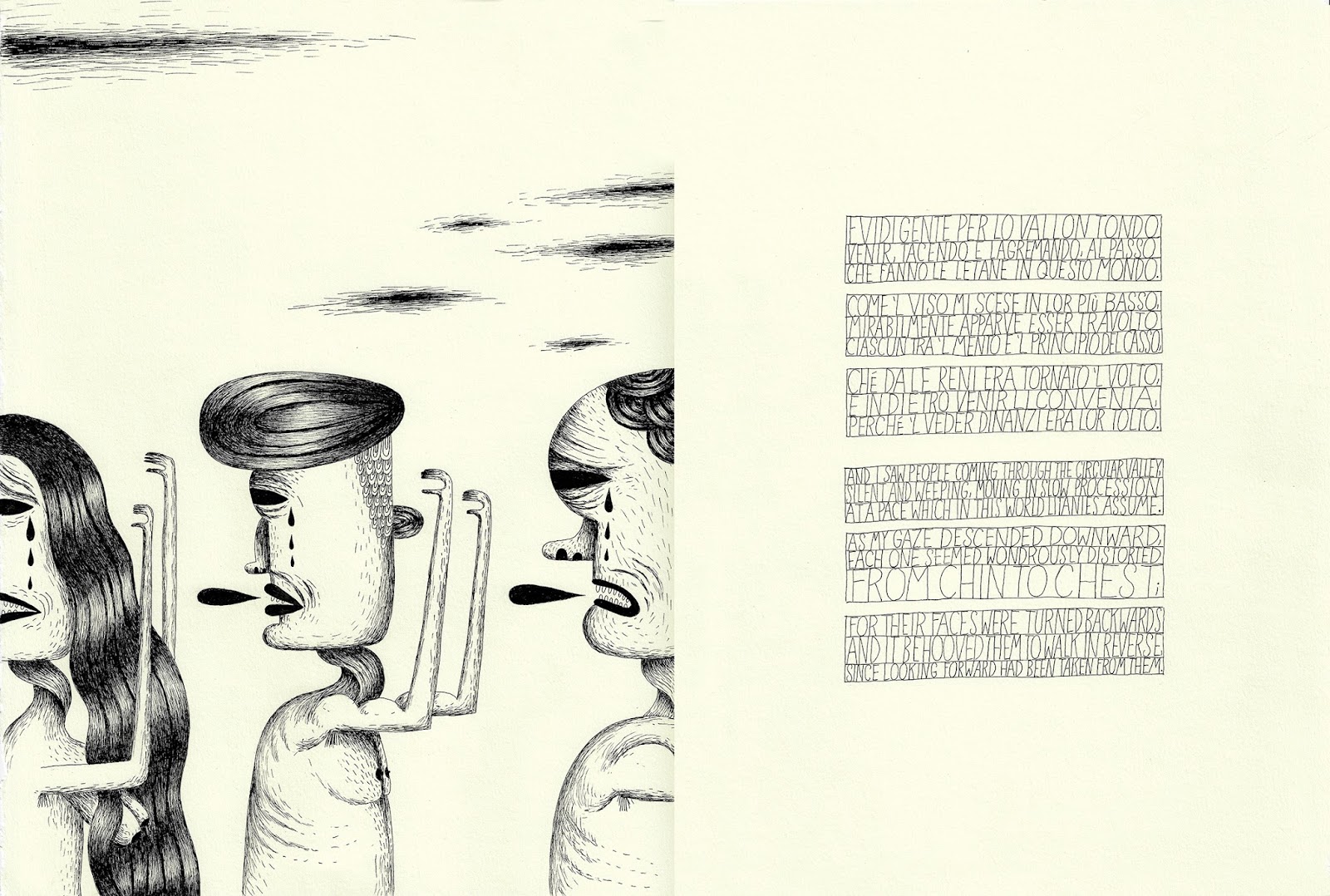
Inferno XX: The Diviners.


Inferno XX: The Diviners
Ink on paper, 2016
22 x 15”

Dante arrives at a chasm which is "bathed in tears of agony," and beholds a gloomy, glacial procession of sinners. These are the diviners: magicians, soothsayers, fortune tellers, and military strategists who dared predict the future. Their perverse punishment is to possess a single mode of expression—incessant tears—while walking backwards with their heads twisted around.

*    *    *

We live where our attention is. When we direct our attention fully to the present moment, we are fully alive. —Eknath Easwaran 

The medieval church considered divination a form of heresy, usurping the omniscience of God as the sole author of fate. Dante's diviners are an absurd brood, weeping in an excruciatingly slow procession while walking backwards, with their heads twisted 180º to enable them to see where they are going.

I'm the least qualified person to discourse on present mindfulness. A consummate worrier, I've nevertheless made an effort, but failed, to "live in the present" over the years. Sure, I believe that the future is not yet a reality and the past cannot be changed, but I spend a lot of time wondering how the consequences of my past idiocy will haunt me in the future.

For years I had a couple of anxiety dreams about the future. One dream was so exquisitely metaphorical that I actually cherished it when it recurred several times, even though it terrified me when it inhabited my sleep. It involved a tornado on the distant horizon, a sure sign of impending doom and destruction. Sometimes I was in a car, and other times I was in some sort of structure—a glass skyscraper, a house, looking out a kitchen window. In each instance I was engrossed in some conversation or some other activity involving other people when my attention would be drawn to the window. Looking out, I would catch sight of the ominous ribbon of black dust and debris, always on the horizon (it had to remain there—otherwise it would be about the present). I would always wake before it tore my life apart.

The second dream was also a recurring narrative that haunted my sleep. It was much more disturbing than the tornado dream, and seemed to be as much about the past as it was about the future. I would find myself in a deep pit somewhere, unable to get out and eventually made aware that I was in the grave with someone I had killed, albeit accidentally. Panic would inevitably ensue when I realized that the body would soon be buried by others, whose voices I could hear approaching from the landscape above. I would soon be discovered and punished, a victim of my own transgressions.

I haven't had either of these dreams for many years, and I do think they stopped around the time that I came out to my kids and separated from the wonderful woman to whom I was married for 20 years. No more fear of consequences for that horrific, unintended crime (which was a metaphor for the secrets I was keeping, I'm sure). To this day, when I reflect on the realism of that dream, I have to remind myself that I'd never harm a fly, and that my future no longer includes fear of being outed as a metaphorical murderer.

Saturday, April 1, 2017

Inferno XVI: Getting Personal with the Sodomites


Inferno XVI: Getting Personal with the Sodomites
Ink on paper, 2016
22 x 15”

Continuing his engagement with the depraved yet beloved souls in the Third Ring of the Seventh Circle, Dante chats with some comical characters, a trio of Florentine sodomites.


*    *    *

Brunetto Latini is left behind, and Virgil encourages Dante to stop and talk to a group of sodomites whose eccentric behavior is alternately absurd and endearing. The main speaker identifies himself as Jacopo Rusticucci, and his friends as Guido Guerra and Tegghiaio Aldobrandi. Highly regarded by Dante in life, these three Florentines were Guelphs who discouraged engagement in battle. The trio behaves with erratic absurdity, joining hands and running in circles as a sort of human wheel as they attempt to dodge the burning flakes of flame. They’re badly charred from their eternal exposure to fire. They question Dante about the state of Florentine politics.

Curiously, as Robert Hollander points out, it’s surprising and very odd that Dante once again treats a group of typically reviled sinners (sodomites) with such affection and respect, just as he did Brunetto Latini in Canto XV. It’s a puzzling aspect of the narrative, this graciousness bestowed upon homosexuals, but there you have it.

I made two versions of this drawing, the first (below, the only bit of it left after destroying it in my use of the ugly mess of paper as an ink blotter) being a complete failure after two full days of toil. I’m still a little unsure why I disliked it so much, but my conviction was profound enough to compel me to start again. I suspect my displeasure came from the lack of energy in the composition—the three guys simply formed a circle dropped in the center of the image. It was also a little too silly in my opinion, despite the relative levity of the scene described by Dante. 


As a 21st century sodomite, I’m much happier with the second, final iteration (top), perhaps because it became an opportunity for some personal critical commentary—a little jab at the bearded Boston bros who desperately cultivate an A-list image. Having hacked away of late at the jungle that is gay dating I think I’ve developed an ability to spot these guys pretty quickly. Most have the requisite muscles and beards—slaves to the trends that elicit a sort of conformist desire. Their Instagram feeds possess an exquisitely balanced ratio of sexy photos of themselves in the gym, sensitive shots of them lovingly playing with dogs or nieces or nephews alongside nocturnal images of Ptown weekends with the boys. Lots of teeth and tank tops. They overcompensate with abundant expressions of interest in sports and beer. They seem friendly, happy. They describe themselves openly as “laid back,” but their grimaces vaguely indicate a deeper underlying anxiety. 

What draws these men to places like Boston, with its competitive, cold, gay subculture? A desperate need for tribal belonging paired with a desire to be desired? Hell bent on transcending, once and for all, lonely childhoods filled with rejection? Tough to say, but so many of these men seem damaged by the time they’re 40, eating themselves alive as they inch toward late middle age.

Sunday, February 12, 2017

Inferno XII: The Minotaur


Inferno XII: The Minotaur
Ink on paper, 2016
22 x 15”

In Canto XII, Dante and Virgil descend a steep slope and encounter at the bottom the mythic Minotaur, a beast with the head of a bull and body of a man. They are in the first ring of the Circle of the Violent, that which holds those who have committed violence against others.

*    *    *

The carnal essence of the Minotaur has alternately thrilled and terrified me since my earliest years. If there's an embodiment of the anxiety I experienced in a sexually repressed childhood (and much of adulthood) it would be this creature, with the physique of a dangerously muscled, hyper-masculine man, topped off with a smoky black bull's head, its dark features obscured by shadows and fur. The half-man/half-beast trope permeated my already anxious brain in many incarnations—including that of a lizard-man known as a Gorn, battling Captain Kirk on Star Trek. It was also fodder for a shitload of bad dreams. In retrospect, it's ridiculous that I would have been afraid of a guy in a plastic reptile suit, gingerly tossing fake punches at William Shatner, but it really did terrify me as a five year-old. 

A little history: I grew up with crippling self-consciousness about my body. I thought that my morbid shyness about it was in some way an index to inferior masculinity, and it remained with me until I first had sex in college. I dreaded going to the beach, turned down many a pool party invitation.  It's dissipated over the years and these days I'm pretty relaxed about my body (although there's certainly a ridiculously flawed logic to feeling less self-conscious about the body I have at 54). 

It started with my budding awareness of myself as a sexual being, I think, and that must have been at about age seven or eight. Growing up in a working class neighborhood in the South, I was at all times surrounded by boys who ran shirtless, dirty and unashamed of their bodies, and I both admired and feared their masculinity. Our equality (or perhaps my sense of intellectual superiority—I had what most of them didn't have, or at least I thought I did) existed only above the shoulders. No qualms about showing my head—it was a nice head, not bad looking, and it had nothing to do with sexuality. Funny things came out of my mouth from time-to-time, and I liked to show off with my face. The anxiety reached its peak in middle and high school years, when the same boys began to regard themselves as post-pubescent studs, exacerbating my insecurities.

But when you put a fecund, ferocious animal's head on an already sexualized, brutal body—primed to do violence against sensitive men—you eradicate intellect. Its mind has been supplanted with thoughtless force, and that's pretty scary.


When I began this drawing, I was reminded of the many depictions I had seen over the years, all of which used the body of the Minotaur to echo beastly savagery, a fitting partner to the bull's head. But, from the start, my impulse was to allow the body to be gently erotic, youthful and delicately drawn with lines that virtually disappear into the page. A grateful nod to Aubrey Beardsley, absolutely, but I hope it's more than imitation of a stylistic convention. I suppose it could have been driven by a latent enjoyment of male nudity, or maybe it's a taming of the beast that scared me so much as a boy. Not sure.

Wednesday, January 18, 2017

Introduction to Inferno: Una Selva Oscura


Introduction to Inferno: Una Selva Oscura
Ink on paper. 2016
22 x 15”

In the opening canto of L’ Inferno, Dante finds himself in a dark wood (una selva oscura) having lost his way in life, both morally and intellectually. Thus begins the journey to Hell, Purgatory and Paradise, before returning to life a saved man.

*   *   *

For a couple of years, I taught a class with a brilliant RISD colleague—Mark Sherman, a medievalist in the Literary Arts and Studies Department. I learned a great deal from our experience, and particularly from Mark, who was not only a knowledgeable scholar but also a perfectly competent critic of visual communication. The class, "Illustrating Dante's Comedy," encouraged deeper reflection on the poem in its entirety, with the challenging premise of total immersion in both scholarly and studio investigation. We met for eight hours each week and talked constantly about the poem, its metaphorical and historical richness and how best to visualize it. I do think it was important for most of the students, as their apprehension of the content—written 700 years ago—was made more meaningful by their attempts at illustrating it, while their literary interpretation deepened their relationship to the content as artists. This was the goal, realized with exactitude through a huge investment of sweat and brain work.

It affected me too, and I remain grateful to Mark for resurrecting the poem for me. I don't think that any other teaching experience—at RISD or elsewhere—has more strongly influenced my own creative trajectory. I began by sketching in class as we discussed the poem and these little drawings eventually took shape as a project that's been consuming my attention for the past several months. Most of us read L'Inferno in high school or freshman lit classes in college, and its pulpy, phantasmal imagery appeals universally to youthful sensibilities. I last encountered L'Inferno (sans the rest of the poem) at age 19, my mind mired in newfound pleasures of freely available sex and beer and (finally, after 12 years of public school in which art class was shoved to the periphery) full-time dedication to art making. But in middle age I suspect the poem resonates more profoundly as it mirrors the preoccupations of people (like myself) whose paths in life are pondered with affection, regret, lost love, resentment and a desire to clarify, once and for all, the rest of the journey. Pick up Dante at age 50 and it will be a different literary experience. Spend many hours translating and drawing its tercets of terza rima and you'll realize how much you have in common with a 14th century poet, despite the hundreds of years and linguistic traditions that separate you.

I'm on sabbatical from teaching Illustration at RISD. My proposal, which was submitted in earnest many months ago, boldly (and with naive, puppy-dog enthusiasm, I will admit it) involved completion of 100 drawings based on La Commedia, an ambitious undertaking, to say the least. I've knocked a dent in it but I have a long way to go, of course. I still have time, and—as I near the ninth circle of hell in my efforts to illustrate this huge masterpiece—I'm probably about as intimidated as our hero was just before he encountered Lucifer, embedded in ice and chomping away on three sinners.

Recently (and I'm surprised that I never bothered to research this before) I took a look at relevant dates for the poem's creation. It took Dante, politically and socially exiled from Florence and couch surfing in other Italian cities, twelve years to complete the poem—from 1308-1320. He was, during its creation, between the ages of 43-and 55 years old. Coincidentally  (or perhaps not) at age 43 I came out to my kids, friends and colleagues after almost 20 years of marriage to a beautiful, wise and forgiving woman and found myself in a dark wood: una selva oscura. Desperate for jarring change and a fresh start, I moved to Rome to teach for RISD and enjoyed the departure from routine for two transformative years. This was certainly a momentous turning point in life and the beginning of a period of introspection and self-awareness that has culminated in innumerable life changes. During the past eleven years I have experienced a protracted awakening. I stopped drinking. I enjoyed a seven-year relationship with a man I met in Rome. I became vegetarian. I tried to steer my kids from harm as they teetered on the cusp of adulthood. I lost my mother, a beautiful force of nature, who passed away a month ago at age 96. I looked back on the countless mistakes and losses I experienced along the way. I became a more courageous man.

I'm not presumptuous enough to liken my own artistic pursuits to those of Dante, but I've been awed by the richness of experience this project has afforded me. I have undertaken it analogously, approaching each canto, from beginning to end, in the proper sequence. Like Dante, I begin in the dark wood, wondering how the hell I got here, grateful for so much but cursing myself for squandering some unusual gifts. The project has been deliberately structured as time-consuming (and occasionally maddening, especially when my own lack of resourcefulness or other obstacles slow me down). And, more than any other aspect of learning it has afforded me, I have been allowed to study my own processes—intellectual, formal and technical—and this is precisely what the gift of sabbatical is about. 

I'm including below the opening lines to L'Inferno, no doubt mirroring the experience of many of my brothers and sisters in mid-life, along with Henry Wadsworth Longfellow's 1867 translation:


Nel mezzo del cammin di nostra vita
mi ritrovai per una selva oscura,
ché la diritta via era smarrita.


Midway upon the journey of our life
I found myself within a forest dark,
For the straightforward pathway had been lost.