Showing posts with label writing. Show all posts

Thursday, November 9, 2017

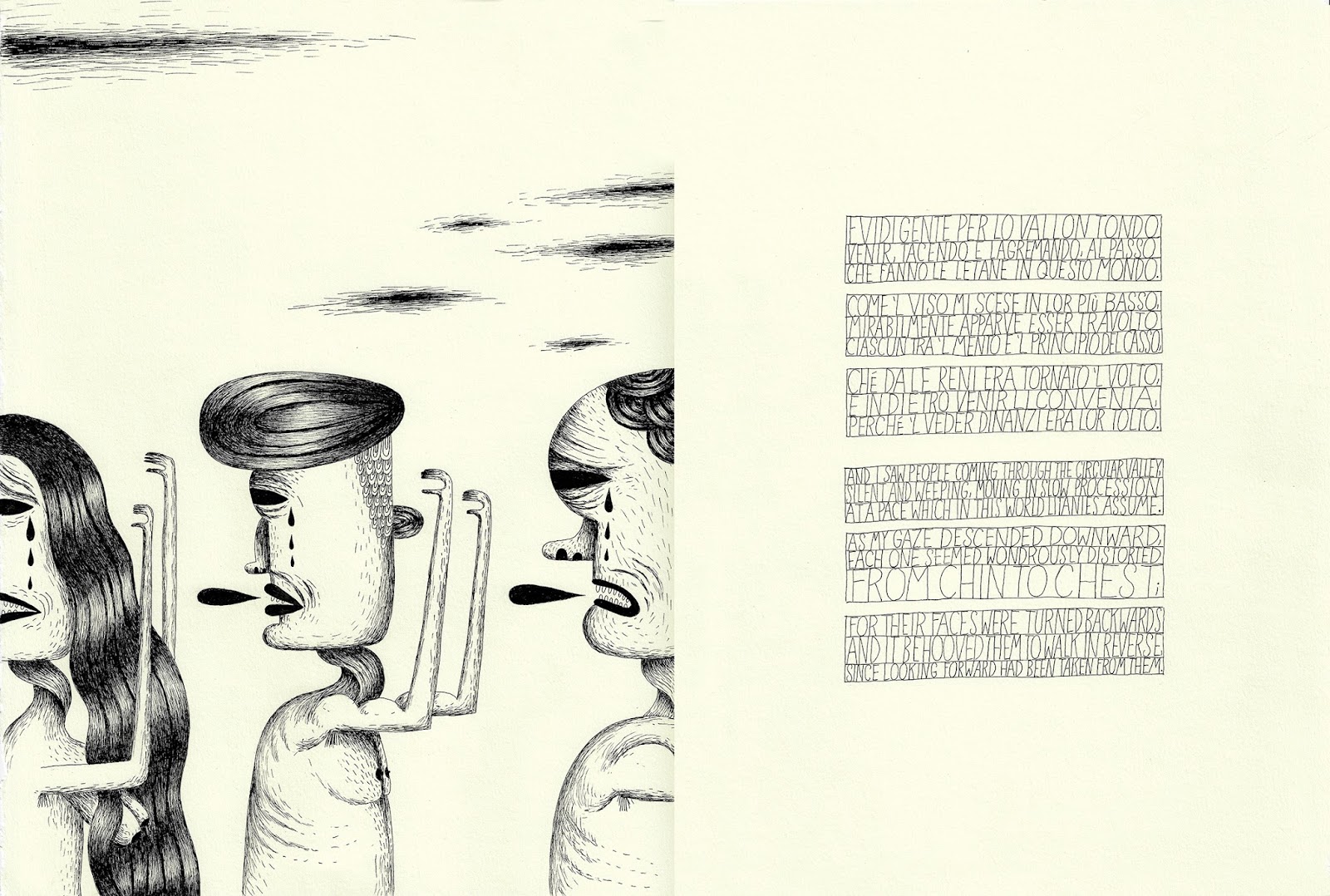
Inferno XX: The Diviners.


Inferno XX: The Diviners
Ink on paper, 2016
22 x 15”

Dante arrives at a chasm which is "bathed in tears of agony," and beholds a gloomy, glacial procession of sinners. These are the diviners: magicians, soothsayers, fortune tellers, and military strategists who dared predict the future. Their perverse punishment is to possess a single mode of expression—incessant tears—while walking backwards with their heads twisted around.

*    *    *

We live where our attention is. When we direct our attention fully to the present moment, we are fully alive. —Eknath Easwaran 

The medieval church considered divination a form of heresy, usurping the omniscience of God as the sole author of fate. Dante's diviners are an absurd brood, weeping in an excruciatingly slow procession while walking backwards, with their heads twisted 180º to enable them to see where they are going.

I'm the least qualified person to discourse on present mindfulness. A consummate worrier, I've nevertheless made an effort, but failed, to "live in the present" over the years. Sure, I believe that the future is not yet a reality and the past cannot be changed, but I spend a lot of time wondering how the consequences of my past idiocy will haunt me in the future.

For years I had a couple of anxiety dreams about the future. One dream was so exquisitely metaphorical that I actually cherished it when it recurred several times, even though it terrified me when it inhabited my sleep. It involved a tornado on the distant horizon, a sure sign of impending doom and destruction. Sometimes I was in a car, and other times I was in some sort of structure—a glass skyscraper, a house, looking out a kitchen window. In each instance I was engrossed in some conversation or some other activity involving other people when my attention would be drawn to the window. Looking out, I would catch sight of the ominous ribbon of black dust and debris, always on the horizon (it had to remain there—otherwise it would be about the present). I would always wake before it tore my life apart.

The second dream was also a recurring narrative that haunted my sleep. It was much more disturbing than the tornado dream, and seemed to be as much about the past as it was about the future. I would find myself in a deep pit somewhere, unable to get out and eventually made aware that I was in the grave with someone I had killed, albeit accidentally. Panic would inevitably ensue when I realized that the body would soon be buried by others, whose voices I could hear approaching from the landscape above. I would soon be discovered and punished, a victim of my own transgressions.

I haven't had either of these dreams for many years, and I do think they stopped around the time that I came out to my kids and separated from the wonderful woman to whom I was married for 20 years. No more fear of consequences for that horrific, unintended crime (which was a metaphor for the secrets I was keeping, I'm sure). To this day, when I reflect on the realism of that dream, I have to remind myself that I'd never harm a fly, and that my future no longer includes fear of being outed as a metaphorical murderer.

Wednesday, August 9, 2017

Inferno XIX: Comeuppance.


Inferno XIX: The Simonists
Ink on paper, 2016
22 x 15”

Our heroes have arrived at the lip of the third bolgia in the eighth circle of hell. Looking across the expanse of stone, they see spirits buried upside down in holes in the ground—dozens of legs kicking spasmodically as the soles of their feet are licked by oily flames. They are, no doubt, very uncomfortable, having been shoved head first into stone. These are the simonists, people who used ecclesiastical positions of power for personal gain, and among them is a particularly noteworthy offender.

*    *    *

"Sometimes, when I lack the motivation to get out of bed and start the day, I remember revenge..."

Thus spake a particularly witty friend on Facebook last week, delighting me with his self-mocking spitefulness. I'm happy to boast that I'm not a vindictive person, but I do love a good tale of revenge in film and literature. Farrah Fawcett in Extremities, imprisoning her vile attacker in a fireplace. Hansel and Gretel, giving the momentarily clueless witch a run for her money into a blazing oven. Hamlet, hell-bent and psychotically obsessed with avenging his father's fratricide. And of course, there's Steven King's Carrie, launching a blazing, telekinetic massacre in a high school gym while drenched on stage in pig's blood. You go, girl.

Dante sometimes seems all about retribution, and—like many before and after him—he deftly utilizes narrative fiction to skewer his nemeses, wresting complete control in life's infinite power struggle by indulging himself and his reader in wicked comeuppance for transgressors. Dante delights in the imaginary punishment of his contemporaries by an omnipotent God, and their humiliation is made all the more public in the incremental distribution of his poem to the populace.

It's no coincidence that the simonists are buried in holes that resemble baptismal fonts. This instrument of purification and rebirth is perfectly suited to Dante's exquisite irony, and the lead recipient of this punishment is none other than Pope Nicholas III, who foreshadows the eventual arrival of (in Dante's eyes) an even more deserving papal cad—Pope Bonafice, the political leader of the Black Guelphs, the group that banished Dante from his beloved Florence. 

Comeuppance is a word perfectly suited for the concept of exacted revenge, and Dante masterfully guides it in Canto XIX, as things are turned around, over and upside down with cruel yet delightful irony. 

Sunday, April 23, 2017

Inferno XVIII: Fecal Matter


Inferno XVIII: Fecal Matter
Ink on paper, 2016
22 x 15”

Dante has arrived in the eighth circle of Inferno, in the first of ten pouches (ditches) called the malebolge (translated as “evil pouches”). Here he witnesses a band of panderers (pimps, flatterers, et al), tormented by demons as they move in procession along the floor of the valley His gaze is arrested by the sight of one pathetic sinner whom he recognizes, covered with a thick layer of excrement.

*    *    *

Dante’s cruel sarcasm is on full display in his exchange with Alessio Interminei of Lucca, a flatterer who asks Dante why he feels compelled to stare him down more than the others. The retort is mean-spirited and antagonistic:

"Why, if I remember,

I saw you once before with dry hair.
You are Alessio Interminei of Lucca,
so I study you more than all the others.”

Dante’s towering literary reputation sometimes overshadows his arrogance and cruelty. He can be a tool, but he’s still funny as shit.

This is a shitty drawing in more ways than one. I’m pleased enough with the bottom half, but the top surrenders itself to whimsy, my eternal predilection. Not that whimsy can't be terrifying. Just ask the two foolish children who, lured by promises of treacle tarts by the androgynous, superficially mirthful Child Catcher, met sudden, horrifying entrapment in Chitty, Chitty, Bang, BangThe bottom of my drawing is certainly whimsical, but there is to me more perversity in the characterizations and the way lines, visual hierarchy, and other formal/design decisions contribute to a sense of severe agony in its figures. I need to do something about the demons—they’re a bit more like characters from The Rocky and Bullwinkle Show than the fierce antagonists they’re meant to be. Maybe I’ll simply obfuscate them in an inky cloud. Things are scarier when you can’t quite see them.

I need to study how imagery evolves this way for me, how some parts go wrong while other parts seem to fall in place almost effortlessly (although I should be careful to say that nothing ever feels effortless); how sketches sometimes seem more essential and honest than finished drawings or, conversely, how finished drawings finesse the seeds of simple ideas into more sophisticated form. I had a wonderful student once, Matt Leines, who had undertaken an independent study project with me. We met every week to discuss his ideas, and I recall at one point he came to me with an expression of frustration. He had a sketch—small and in a notebook—and he had a finished illustration—a bit larger. His question was simple: “why doesn’t this look like that?” In other words, what was it about the sketch that he had been unable to apprehend in the finished image? We went round and round and—apart from the typical technical explanations (eg.: perhaps his use of mediums didn’t translate well at larger scale and on a different substrate?) I think we ultimately decided that sometimes the honest impulse for mark-making, the exploration of form and meaning in its most naive, open and meandering mode of drawing and painting, is impossible to replicate.

So, some things turn to shit.

Friday, April 7, 2017

Inferno XVII: The Face of A Just Man


Inferno XVII: The Face of A Just Man
Ink on paper, 2016
22 x 15”

In this canto, Dante and Virgil meet Geryon, the winged monster of fraud, who rises from the abyss to transport them downward, from the edge of towering cliffs to the eighth circle of Inferno.


*    *    *

Geryon is an ancient mythic character whose early appearance in Greek myth bears little resemblance to the 14th century monster Dante created for Canto XVII of L’Inferno. Often freely transforming characters from history and literature (King Minos of Crete, for example, in Canto V, is transmogrified into a beastly guardian of hell with a serpent’s tail) Dante’s poetic license never fails to deliver with absolute potency the moral lessons he most wants to convey. And, truth be told, it’s easy to accept that once a character enters the underworld, just about anything can happen. Kings grow tails and mythic Greek monsters change costume.

The story is about to dedicate itself to the world of sins collectively known as fraud, a particularly detestable offense in Dante’s estimation. The eighth circle features the Malebolge, a sequence of ten ditches wherein fester perpetrators of all classes of fraud: panderers and seducers; flatterers, simoniacs (those who sold ecclesiastical favors); sorcerers; barrators (corrupt politicians); hypocrites; thieves; counsellors of fraud; sowers of discord; and falsifiers.

Geryon is described as the “foul effigy of fraud,” and this is expressed in his chimeric corporeality: he has a reptilian body, lavishly decorated and resembling a middle-eastern carpet. His arms are hairy and a deadly scorpion’s tail is concealed at the end of his enormous body. But his most fraudulent attribute is his deceptive visage: “the face of a just man.” 

Throughout La Commedia, Dante integrates significant use of the number three in imagery, structure and narrative. Robert Hollander brilliantly discusses Geryon as one of the most cleverly crafted metaphors of the poem: “This embodiment of fraud is thus presented as the counterfeit of Christ, three-in-one rather than one-in-three.”

I really loved making this drawing—the scale of the monster is extremely exaggerated in my conception, much bigger than I’ve seen him represented in the precedents I researched. And, on a technical note, somehow the pen behaved itself (for once) and I was able to pull it off to my satisfaction.

Monday, March 6, 2017

Inferno XIV: The Old Man of Crete


Inferno XIV: The Old Man of Crete
Ink on paper, 2016
22 x 15”

A fantastic interlude occurs in the fourteenth canto of L’Inferno as Virgil revives imagery from Nebuchadnezzar’s Dream, an image of a giant statue made from various materials, from precious and strong on the top to crumbling clay at the bottom.

*    *    *

After leaving the Forest of Suicides Dante and Virgil traverse the burning sands of the the seventh circle of hell. Their conversation is set aside for a time as Virgil relates the allegory of the Old Man of Crete, an image borrowed from the second chapter of the Book of Daniel, in which the great King Nebudchadnezzar is visited by a dream of a giant statue, metaphorically composed of various materials—strong to weak, precious to worthless. In Virgil’s description the statue is an enormous colossus, emerging from the side of Mount Ida in Crete. 

The statue’s back faces Egypt, heretofore the world’s dominant society, and looks to Rome in deference to Christian rule. As a symbol of humanity’s crumbling moral and political fortitude it has a head of gold, arms and breast made of silver, bronze abdomen and thighs, and iron legs. His right foot, upon which he rests most of his weight, is made of crumbling, kiln baked clay, a symbol of the deteriorating institution of the medieval Catholic Church. He cries tears (through cracks in his body, not as I have depicted it in the illustration) which on the ground below create the four rivers of Inferno: Acheron, Styx, Phlegethon and Cocytus. 


This is my favorite drawing so far, in part because of the sheer complexity of the image I needed to make. I relied a bit on ancient conceptions of Nebudchadnezzar is developing the costume and styling of hair and beard (see below), and really enjoyed interpreting the various active aspects of the image, finding concise and iconic ways to indicate is gaze, the tears, the geography, and materiality.


Saturday, February 18, 2017

Inferno XIII: The Forest of Suicides


Inferno XIII: The Forest of Suicides
Ink on paper, 2016
22 x 15”

In the second ring of the seventh circle of hell, Virgil encourages Dante to pluck a twig from a thorn tree. Our hero is shocked to discover that the tree is an unnamed suicide, whose plaintive cries and oozing black blood reveal the collective fate of the entire forest.


*    *    *

As Dante and Virgil enter the second of three rings in the Circle of the Violent, they encounter the fate of those who do violence to themselves. Disembodied moans surround them and Virgil tells Dante that if he were to pluck a twig from one of the mangled trees, he might learn the story.

Dante does so, and—weeping with despair and oozing black blood—the tree ultimately unravels his story. He walked the earth as Pier della Vigna, counselor to the Emperor Frederick II. Vigna’s fated suicide was in a strange way the result of his fierce dedication and love for Frederick. His contemporaries grew envious of their close relationship and they circulated ugly rumors, causing him great shame, despair and—ultimately—death by his own hand.


In search of a different language for this drawing, I’ve developed something more of a design. 

Saturday, February 11, 2017

Inferno XI: The Circle of the Violent


Inferno XI: The Circle of the Violent
Ink on paper, 2016
22 x 15”

Canto XI is one of the more pedantic parts of L'Inferno. Dante and Virgil descend to the seventh circle, housing those who have committed violent acts in life. It is subdivided into three smaller rings to accommodate sinners who are guilty of various classifications of violence.

*    *    *

The violent are punished in a variety of ways, depending on the transgressions they committed on earth. The seventh circle is sub-divided into three rings, each of which metes out a unique punishment. In the first ring, flooded by a river of blood, those who have committed violence against God and nature languish eternally. These are the plunderers, murderers and thieves who once corrupted the earth. The second ring is reserved for those who committed violence against themselves. Ingeniously, Dante conceives of a forest of suicides, wherein sinners have been transmogrified into talking, thorny threes, oozing blood. The third ring is for those who have perpetrated violence against their neighbors, including blasphemers and usurers, who suffer eternally in a desert of burning sands. Virgil explains that fraud is the greatest of sins in this circle, because it is the transgression most unique to mankind.

The eleventh canto is unique in its instructive tone, with a large portion devoted to Virgil's explanation of how the circle is subdivided, classified and populated. I had a couple of goals in mind in structuring this picture: depiction of dialogue as key to its substance (the face-to-face, plain as day positioning of the two heroes), and a didactic representation of the three rings concentrically arranged—the river of blood, the suicide trees and the burning sands. I liken it to a conversation between teacher and pupil, poised before a diagram.

Tuesday, February 7, 2017

Inferno X: Farinata degli Uberti


Inferno X: Farinata degli Uberti
Ink on paper, 2016
22 x 15”

In one of the most theatrical and haunting moments of L'Inferno, Dante is recognized by Farinata degli Uberti, a Florentine military leader and politician. In passing an expanse of flaming sarcophagi, Dante is stopped by the voice of a fellow Florentine, who recognizes his Tuscan accent. The two have a little chat about Florence, their families and honor.

*    *    *

In the sixth circle of Hell, we meet two of the heretics damned to remain there, including Farinata, whose family feuded with Dante's in Florence. Farinata recognizes Dante's Tuscan accent and, rising eerily from his sarcophagus, he engages him in debate about the honor of their respective families. 

Early on, in the Gates of Hell illustration, I first integrated an iconic reference to Florence in the fleur-de-lis, and I've attempted to revive it here in the silhouette created by Farinata's figure and the flames bursting from all sides of his body as he rises from the grave. Additionally, much has been made of the imagery Dante evokes in Farinata's pose. Seen from the waist up he has reminded many a scholar of the Man of Sorrows, a trope of the newly resurrected Christ, displaying the wounds of crucifixion with profound grief. In this image, Christ is represented as both dead (as man) and alive (as God).


Thursday, February 2, 2017

Inferno IX: The Furies at the Gates of Dis


Inferno IX: The Furies at the Gates of Dis
Ink on paper, 2016
22 x 15”


Arriving at the gates of the city of Dis, Dante and Virgil are accosted by three furies, minions of Medusa. 

*    *    *

Dante and Virgil meet some formidable foes in the furies, Greek figures of vengeance with bat wings and snakes for hair, who carried instruments of torture and punishment: a whip, a chalice of poison and a torch. They hover at the gates of Dis, a walled city whose architecture included mosques (presumably inspired by Jerusalem of the 14th century). Because Islam was a relatively new religion—considered heresy in the eyes of the Church and was certainly not Christianity—its monuments were fitting features of a city whose primary descriptive elements contradict conceptions of Paradiso.


Inferno VIII: "Seize Filippo Argenti!"


Inferno VIII: "Seize Filippo Argenti!"
Ink on paper, 2016
22 x 15”

Dante encounters the Florentine politician Filippo Argenti, and the wrathful cease their violent battle to consolidate their attacks on him. Argenti then begins to tear at himself in due course, making quite a bloody scene.


*    *    *

The wrathful turn on Filippo Argenti, but he literally beats them to the punch, tearing at his own flesh in a frenzy. In Bocaccio's Decameron, Argenti's ire is raised by a practical joke played by Ciacco,  It's been said that Filippo Argenti once slapped Dante, that his brother had claimed Dante's possessions after his exile, and that the whole Argenti family opposed Dante's return. Dante held some pretty big grudges and the Hollanders explain the character in this gloss from their edition of L'Inferno.

“From the cries of others the reader finally learns the name of this sinner (Dante has known exactly who he is—see v. 39). Filippo Argenti was a Black Guelph from a powerful Florentine family. His real name was Filippo Adimari de’ Cavicciuoli, but he supposedly was known as Filippo Argenti because he had his horse’s hooves shod in silver (argento). A number of early commentators relate that his brother, Boccaccino, got hold of Dante’s possessions when the poet was exiled. If that is true, we have here a pretty clear case of authorial revenge upon a particularly hated enemy. See Francesco Forti, “Filippo Argenti,” ED, vol. 2, 1970, pp. 873–76.”

Excerpt From: Dante, Robert Hollander & Jean Hollander. “The Inferno.” 

Wednesday, February 1, 2017

Inferno VII: The Wrathful Smite Each Other in the River Styx


Inferno VII: The Wrathful Smite Each Other in the River Styx
Ink on paper, 2016
22 x 15”

Canto seven includes a scene of great ferocity, as those whose anger and spiteful nature guided them in life are condemned to beat, kick and bite one another while floating in the River Styx.

*    *    *

Dante had a ferocious sense of humor and this is evidenced throughout L'Inferno, wherein he subjects friend and foe alike to dreadful fates—punishments ranging from the inconvenient to the inhumane. He reserved a great deal of his ire for political rivals who are eternally tortured, burned and humiliated in the bowels of Hell. And, while he pitied the misfortune of the timing, he added historical figures who (sometimes merely because they were born before Christianity was in flower) were doomed to lives of boredom, aimlessness or shame. 

In one of my favorite scenes, dozens of furious souls are damned to partake in a raging battle in the bloody River Styx in Canto Seven. Arriving on the scene he sees all manner of chaos and carnage happening among the participants—an angry, mud-soaked mob immersed in the bloody waters, biting, kicking, drowning, punching and slapping each other. 

And yet, somehow this scene carries with it a terrific sense of absurdity, and it's tough to explain why. I suppose the very notion of people immersed in blood, attacking one another with utter malice is terrifying, but somehow it's worth a chuckle:


In la palude va c’ha nome Stige
questo tristo ruscel, quand’ è disceso
al piè de le maligne piagge grige.

E io, che di mirare stava inteso,
vidi genti fangose in quel pantano,
ignude tutte, con sembiante offeso.

Queste si percotean non pur con mano,
ma con la testa e col petto e coi piedi,
troncandosi co’ denti a brano a brano.

_____________________________

It becomes a swamp by the name of Styx,
this sorry brook, when it descends
at the foot of the malignant, grey shore.

And I, who stood intent,
saw muddy people in the quagmire,
all of them naked and inflamed.

They struck each other not only with their
hands, but with their heads, breasts and feet,
and tore each other piece by piece with their teeth.


For me, head butts are entirely reminiscent of the theatrical absurdity of pro wrestling, and Dante's refined and shocked countenance adds a bit more to the spectacle.